For much of its 130-year history, the annual lawn-tennis championship at the small, private Queen's Club in West London has mainly been seen as a run-up to Wimbledon, the intimate rehearsal dinner before the grass-court royal wedding three miles across town. The playing surfaces are superb and the competition is elite, with Boris Becker, Pete Sampras and Andy Murray among its champions. But the scale is smaller and the setting, a cluster of buzz-cut courts surrounded by modest Edwardian townhouses, a bit less twee than the tennis traditionalism that follows at Wimbledon. Fewer hats, more tatts.
Serena Williams Takes Center Stage
Then Serena Williams showed up, walking onto the main court to launch one of the most anticipated tennis comebacks in decades. The Queen's Club, suddenly, was the centre of the tennis universe. After stepping away from professional competition four years ago, Williams, 44, announced on June 1 that she was returning for another go at this local club, where she has never played because, until last year, Queen's hadn't held a women's tournament since 1973.
Tickets sales soared, selling out the usually sleepy second day of play. Overwhelmed organizers had to turn down credentials requests from media outlets around the world who had previously shown little interest. Tuesday was wall-to-wall with enthusiasts eager to catch the first sets of Williams's return.

A Fan's Perspective
“I've been to Queen's for years but never on a weekday,” said Alex, a fan waiting in a queue for a Pimm's cup, who declined to give her last name because she had called into the restaurant where she works with a stomach bug. She's actually a manager. “I know, it's awful, but I very much wanted to be here for this. It feels more like the finals than a first-round doubles match.”
The Match Victory
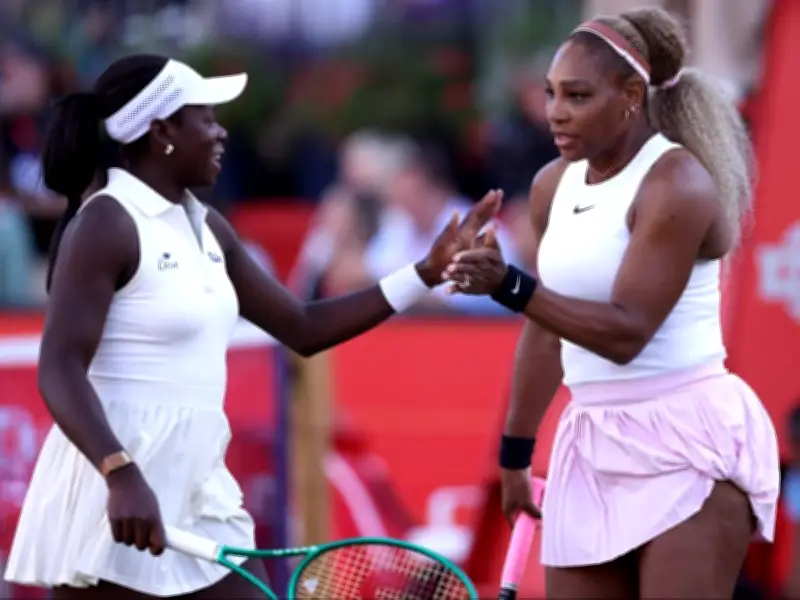
Williams started her comeback predictably: by winning a doubles match with her first-time partner, the 19-year-old Canadian phenom Victoria Mboko, 7-6 (7-2), 6-2, beating third seeds Erin Routliffe and Nicole Melichar-Martinez. The queen and the teen. Most of the crowd were on their feet before Williams even reached courtside. They shouted “Go Serena” as she limbered up in a pink skirt, pink warm-up jacket and pink shoes. They roared when she slashed her first grunting two-handed backhand out of Routliffe's reach and cheered her first serve since September 2022, a fault.
But her first win is only the beginning. Williams will play at least one more match at the Queen's Club and, win or lose here, has already committed to another doubles outing at the Berlin Tennis Open next week. Wimbledon kicks off just days after that. Williams hasn't tipped her hand, but the feverish speculation around her return is now focused on the will-she-or-won't-she question of that Grand Slam grass tournament, where she has already won the doubles title six times and a wild card invitation — which will be announced next week — is likely hers for the asking.
Grand Slam Ambitions
Of course, she's also hoisted the single's championship silver salver at Wimbledon seven times, some of the 23 Grand Slam titles she bagged before retiring in 2022, one short of the record held for 53 years by Australian Margaret Court. Is that what Williams is gunning for, one more Grand Slam title to cap her already remarkable life record by tying Court? Winning two to surpass her? She hasn't said. Asked at a pre-tournament news conference why she had reversed her retirement, she just said, “Why not?”
Global Fan Excitement
Those who came to see her Tuesday appeared just thrilled to see her back. Mukami Wambora had never heard of the Queen's tournament, officially the HSBC Championships, but the day after Williams announced her return, Wambora booked a flight from her home in Kenya for a one-night stay in London. Never seeing Williams play live had been a black mark on her bucket list. Her theory of the case: That her all-time favorite player is coming back because she wants to give her fans — and her own two children, one of whom was born a year after she retired — another chance to see her on the court.

“She has nothing to lose, she had nothing to prove, I think she just wants to have fun,” said Wambora, taking selfies of herself amid the throngs heading into the Andy Murray Arena, the pop-up 9,000-seat grandstand built each year in the club members' parking lot. “For us, the people who didn't get to watch her before, we get to enjoy her tennis without any pressure.”
Wambora also suspects Williams's aims may be less about adding titles and more about continuing to challenge the game the way she has since she emerged from Compton, Calif. Her choice of Mboko, who streaked from a world ranking of 115 to the top 10 in two years, is part of that. “I do think she intentionally picked someone who's also a person of color, who's coming up in the game,” Wambora said. “She's about uplifting other people. She gives us all a voice.”
Technical Analysis
The aficionados were more about her technique, sussing out how far her body — trimmed by the GLP-1 weight-loss drug she has taken since struggling to shed pounds after her second pregnancy — might take her in a professional game that has only gotten more physical since she left it. Did her serve still have the power she would need to hold her own against players who were watching her on television when they were 10?
Williams had been teasing the tennis world with hints of a comeback for years. Within weeks of calling it quits at a post-match news conference in 2022, she was posting Instagram pictures of new rackets — “I'm a little bored” — and coyly praising Tom Brady's serial un-retirements. But it was only last October that she quietly re-enrolled in tennis's anti-doping program, a requirement for professional play, and began taking practice matches with ranked players. She flatly denied it in December — “Omg yall I'm NOT coming back,” she posted — but tennis paid no mind.
Expert Opinions
“She's not just rocking up at Queen's to have a laugh,” said Simon Cambers, a dean of British tennis journalism and president of the International Tennis Writers Association. “This is somebody who's won 23 Grand Slams.” Cambers doesn't know how far the 44-year-old can go in a game where training and technology — carbon nanotube frames, hybrid strings, pressure-mapping shoes — makes it seem that anybody can beat anybody on any given day. At last week's French Open, 114th-ranked Maja Chwalińska became just the second low qualifier to reach a Grand Slam final. “These things didn't happen in the past,” Cambers said. “It's going to be far from easy, but well, you know, she's Serena Williams.”
“She's Serena Williams” is the answer to a lot of unanswerable questions about what might come next. Martina Navratilova was a year younger than Williams when she began a comeback at 43, won the Australian Open and Wimbledon mixed doubles titles at 46, and claimed her final Grand Slam — the U.S. Open mixed doubles — just before her 50th birthday. But of course, she's Martina Navratilova. On the right surface, in the right format, elite tennis has a longer shelf life for the best players than the sport usually admits.
“I think in the last 15 or 20 years, the careers of tennis players have gone longer and longer,” said Pam Shriver, who won 22 Grand Slam doubles titles across a 19-year career. “You have that champion mindset and Serena has looked at the top of the game and thought, 'I wonder how I would measure up.'”
Post-Match Reactions
After the match, Williams seemed pleased. “It was actually really fun,” she said to fans, many of them still standing. “I had nothing better to do,” she continued. “I got tired of sitting at home.” She was still deciding about Wimbledon, she said. Later, to reporters, she gave herself a passing grade, but not more, after four years away. “Don't be hard on yourself,” Mboko said, and then asked her partner, who had won seven grand slams by the time Mboko was born in 2006, for a selfie.