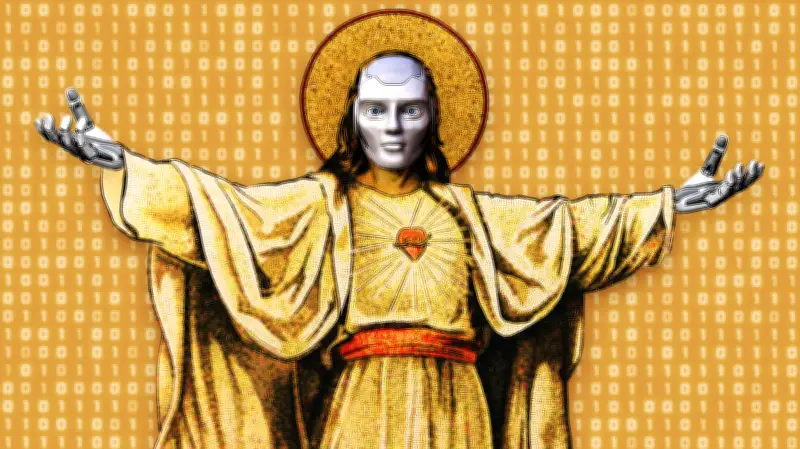
When Denise Kundai moved to the Dallas-Fort Worth region from Arkansas, she lacked a church community and close friends. So she turned to ChatGPT for spiritual advice. As a systems engineer, she was accustomed to using OpenAI's chatbot for work, but soon began asking questions about her Christian faith.
AI as a Virtual Pastor
Kundai used ChatGPT multiple times a day for about 18 months until May 2025. She sought advice on family conflicts and broader life questions from a Christian perspective. The bot would provide scriptures and offer to pray, which made her feel seen. “It starts to feel like there’s a person behind it until you remind yourself, ‘No, this is a machine,’” she said.
Kundai is among many Christians who have used AI for spiritual growth. A May survey of over 1,500 U.S. adults found that 48% of practicing Christians trusted AI for spiritual growth, and one in three believed AI’s guidance was as trustworthy as a pastor’s.

Expert Concerns
Beth Singler, an assistant professor in digital religions at the University of Zurich, warned that large language models are not equivalent to trained theologians. “The large language model is seen as being taught everything that someone who might study theology for years, but that’s just not true,” she said. AI can also hallucinate incorrect information, as seen when a Catholic chatbot named “Father Justin” began offering absolution and suggesting baptizing babies in Gatorade.
Father Michael Baggot, a priest and bioethicist, acknowledged the appeal of on-demand counsel but cautioned against idolatry. “If you are turning to an AI Jesus as a substitute for God, you’re falling into a form of idolatry,” he said. He emphasized that AI cannot replace the human experience of prayer.
Limitations and Risks
AI platforms are created by corporate entities with their own agendas, which can influence responses. Singler noted that Elon Musk’s Grok AI has echoed his political views. Additionally, AI cannot reliably interpret religious texts like the Bible.
Kundai eventually stopped using ChatGPT for spiritual guidance after it misquoted a scripture verse. “If you’re wrong this time, how many times have you been wrong?” she questioned. She now relies on friends for support and uses ChatGPT only for administrative tasks.
While AI can serve as a tool to jumpstart reflection, experts stress it should not replace human connection or prayer. “AI systems can emulate some functions, but they cannot transmit lived experience of brokenness or redemption,” Baggot said.