Researchers at the University of Calgary have unveiled a groundbreaking technological advance in the fight against canola pod shatter, a development poised to offer farmers more tools and potentially greater economic resilience.
The Billion-Dollar Problem of Pod Shatter
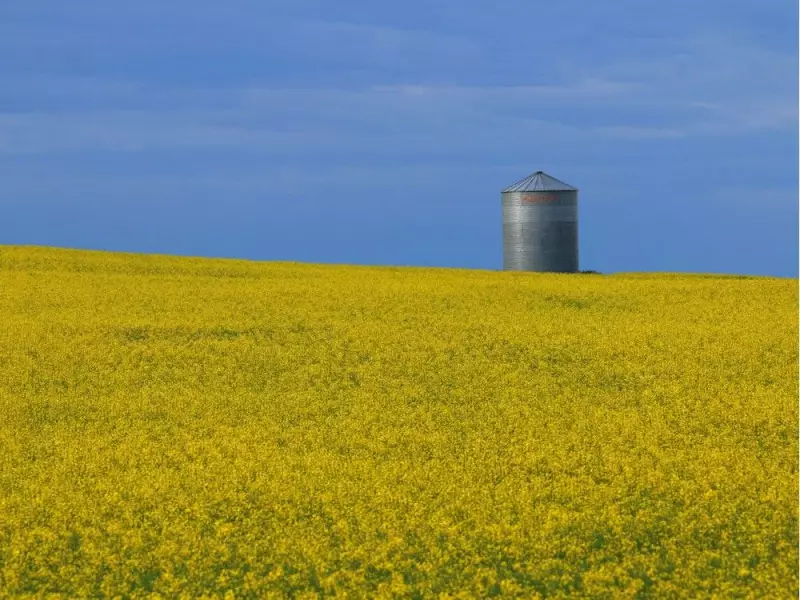
During harvest, the delicate pods containing valuable canola seeds are prone to shattering during the cutting process. This results in significant seed loss, which researchers quantify as averaging three per cent of the total crop. On a national scale, this translates to a staggering economic impact of approximately $1.3 billion annually. In extreme cases, such as during harsh weather conditions, losses can skyrocket to as much as 50 per cent of a farmer's yield.
Discovering the Genetic 'Cement' Messenger
The key discovery, detailed in a peer-reviewed paper published in the prestigious journal Proceedings of the National Academy of Sciences, centers on a specific gene. Professor Marcus Samuel from the University of Calgary's Department of Biological Sciences explains that as canola pods dry and harden, they produce a natural, cement-like substance called lignin.

"We found that this gene was important for sending the message to the pods to lay the cement, so that the pods become stronger," said Samuel, who served as the corresponding author on the research. He emphasized that the lignin must be present in precisely the right amount—enough to fortify the pod without making it overly tough and difficult to process.
New Options for Farmers and AgTech
This research provides what co-author Logan Skori calls "fundamental knowledge" that can be leveraged to create new, practical technologies. Skori, who also runs a plant biotechnology startup named AgGene, noted that this development is distinct from existing shatter-tolerant systems.
"This provides more options for farmers and small companies that maybe want to get into this field," Professor Samuel added, pointing out that farmers currently pay substantial premiums for the existing shatter-tolerant technology, which is now present in nearly all commercial canola varieties.
AgGene is already applying this knowledge, testing new genetic lines in greenhouse conditions. Skori indicated that field trials for evaluation could commence within the next year. "We're looking for outcomes that improve pod shatter," Skori stated, adding that the same scientific approach is being applied to other valuable crop traits, such as enhanced stress tolerance.
Timely Innovation Amid Trade and Cost Pressures
The innovation arrives at a critical juncture for Canadian canola farmers, who are grappling with escalating seed costs and challenging international trade conditions. Since last year, Canadian canola exports to China have faced severe tariffs, including a 100-per-cent duty on canola oil and meal imposed in March, followed by a 75.8-per-cent tariff on canola seed shipments in August 2025.
Samuel stressed the importance of affordable, accessible technology for producers. This scientific breakthrough from the University of Calgary offers a promising path toward strengthening a vital Canadian agricultural sector against both agronomic and economic pressures.