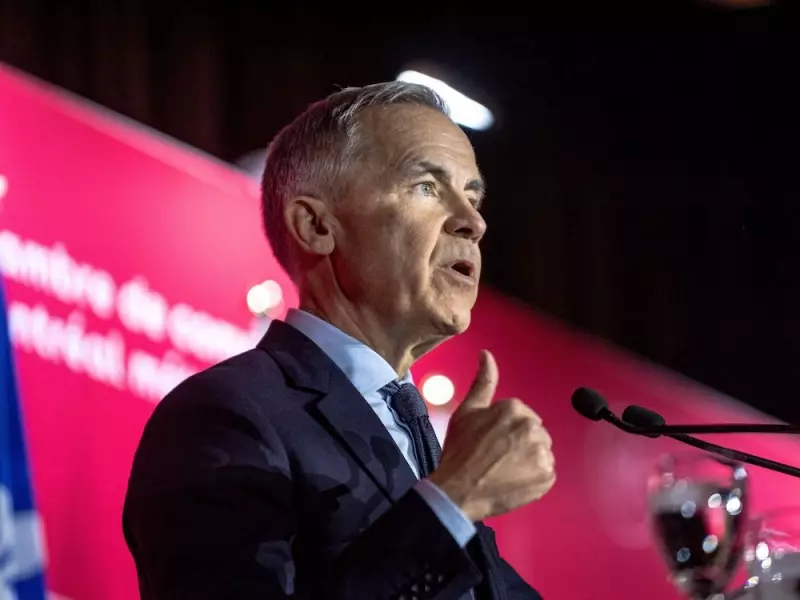
Prime Minister Mark Carney's recent claim that Canada's "rule of law" gives the country an edge in attracting foreign investors over the United States was met with audible laughter from his audience, highlighting a growing disconnect between political rhetoric and economic reality.
Political Fantasy Meets Economic Reality
During a conference organized by the Chamber of Commerce of Metropolitan Montreal on November 14, 2025, Carney positioned Canada as a bastion of stability against what he characterized as the "shaky and unpredictable" nature of the United States. However, financial experts and industry observers immediately challenged this narrative, suggesting the prime minister's comments reveal a fundamental misunderstanding of Canada's actual investment climate.
Richard Ciano, writing for the National Post, described Carney's assertion as "political marketing divorced from economic reality." While investment risk in the United States tends to be political, external, and transactional, Ciano argues that Canada faces deeper, more systemic challenges that are fundamentally more damaging to long-term capital investment.

Systemic Risks Undermining Investor Confidence
The concept of rule of law, when functioning properly, should provide the certainty and predictability that capital demands. However, Canada is increasingly failing to deliver on this fundamental requirement. Instead of clear title and dependable contracts, investors are confronting a fractured federation, weaponized bureaucracy, and legal systems that inject profound uncertainty into basic capitalist principles like property rights.
A recent B.C. Supreme Court decision in Cowichan Tribes v. Canada exemplifies this growing problem. The court's recognition of Aboriginal title to land underlying private properties in a developed area of Richmond didn't directly expropriate land, but it effectively shattered the entire land tenure system. Landowners and businesses now operate within a destabilized legal framework where property ownership itself remains in question.
This judicial decision represents more than theoretical risk—it constitutes what experts describe as a "judicial earthquake" that undermines the very foundation of a stable, investable economy.
Internal Borders and Infrastructure Failures
Carney's characterization of the United States as unpredictable stands in stark contrast to Canada's own internal challenges. The country's greatest infrastructure obstacle remains its internal provincial borders, with 13 jurisdictions often functioning as "squabbling fiefdoms" rather than a unified economic entity.
The Trans Mountain (TMX) pipeline debacle serves as the most prominent example of this dysfunction. The project became so entangled in regulatory gridlock and open inter-provincial warfare—including active opposition from the B.C. government against a federally approved project—that private sector proponent Kinder Morgan ultimately abandoned the project.
The federal government's decision to nationalize the pipeline represents a bizarre outcome for a nation supposedly committed to free-market principles, further eroding investor confidence in Canada's ability to manage major infrastructure projects.
As Canada positions itself against perceived American unpredictability, domestic investors continue to grapple with systemic legal uncertainties and internal political divisions that may pose greater long-term risks to capital investment than the more transparent, if sometimes volatile, political landscape south of the border.