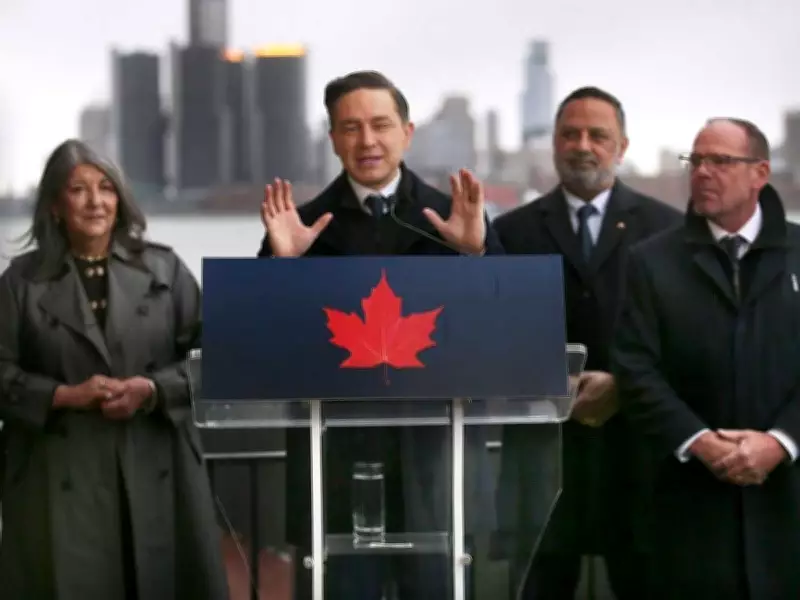
Conservative Leader Pierre Poilievre has launched a bold new automotive strategy, sharply criticizing the Liberal government's approach to trade negotiations with the United States as essentially "waving a white flag." The announcement came during a press conference in Windsor, where Poilievre outlined a comprehensive plan focused on securing tariff-free access to the crucial U.S. market while revitalizing Canadian auto manufacturing.
Critique of Liberal Trade Strategy
Poilievre accused Prime Minister Mark Carney of failing to deliver on election promises to protect automobile sector jobs. "He has since waved the white flag," Poilievre declared. "He seems to have accepted that American tariffs are permanent. He also seems to think that he can carry out a permanent rupture with the United States market in favour of other markets."
The Conservative leader emphasized the continued dominance of U.S. markets for Canadian auto exports, noting that Americans purchase approximately 90% of vehicles manufactured in Canada. "We buy almost the rest, meaning there are almost no overseas exports of Canadian automobiles today, and that cannot be changed on a dime," Poilievre explained, highlighting the sector's vulnerability to U.S. trade policies.

Key Components of the Conservative Auto Plan
Tariff-Free Access and Production Ratios
The centerpiece of Poilievre's proposal involves establishing a tariff-free auto pact with the United States that would implement a "one-for-one production-to-sales ratio." Under this system, for every vehicle produced in Canada, manufacturers would gain the ability to sell a U.S.- or Mexico-made car in Canada without import duties.
Poilievre contrasted this with the current CUSMA agreement, which he said results in Canada and the U.S. producing only 0.6 vehicles for every vehicle purchased. The Conservative plan aims to significantly boost Canadian auto production from 1.2 million vehicles last year to two million vehicles over the next decade.
Tax Changes and Subsidy Elimination
In addition to the tariff-free access proposal, Poilievre announced his plan would eliminate the Goods and Services Tax (GST) from Canadian-made vehicles. This measure is designed to make domestically produced automobiles more affordable for Canadian consumers while supporting local manufacturing.
The Conservative leader also pledged to end the Liberal government's electric vehicle subsidy program, which was reintroduced in February. Poilievre framed this as part of a broader strategy to reduce government intervention in the automotive market while focusing on trade policy improvements.
National Security Considerations
Poilievre's proposal includes a ban on vehicles utilizing software connected to China or Russia, addressing growing concerns about foreign technological influence in critical infrastructure. This security-focused component reflects broader Conservative priorities regarding technological sovereignty and national security.
Political Context and Industry Impact
The announcement comes amid ongoing trade tensions with the United States, particularly following former President Donald Trump's tariff policies that Poilievre cited as contributing to recent auto job losses in Canada. The Conservative leader expressed confidence that his plan would appeal to U.S. interests as well, suggesting it would increase production on both sides of the border.
Poilievre was joined at the Windsor Club press conference by MPs Kathy Borrelli, Harb Gill, and Chris Lewis, signaling party unity behind the proposed automotive strategy. The plan represents a significant policy alternative to the Liberal government's approach, setting the stage for continued debate over Canada's automotive future and its relationship with its largest trading partner.