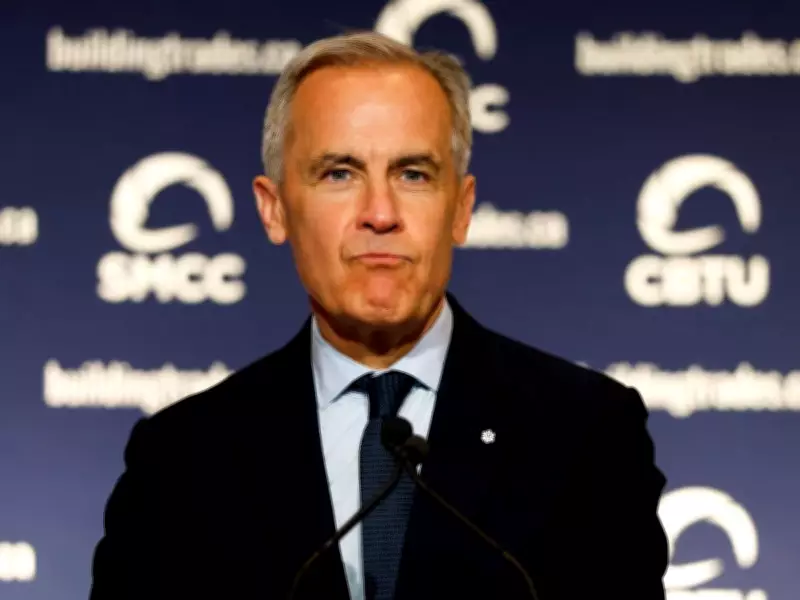
So much for 'buy Canadian' as a federal government policy. The Department of Public Works has stated that some companies that are 100% foreign owned still qualify as 'Canadian' under Prime Minister Mark Carney's 'Buy Canadian' policy, according to Blacklock's Reporter.
Records show the definition of Canadian is so broad it would apply to foreign-owned corporations with storefront branches in Canada, such as the Bank of China.
'The policy does not establish a share ownership threshold,' the department wrote in a report to the Senate national finance committee. 'The policy does, however, outline specific criteria for determining whether a company qualifies as a Canadian supplier.'

The report said only a street address, one employee, and a GST number are required to be considered 'Canadian.'
'Canadian supplier means a supplier that has a place of business in Canada where it conducts activities on a permanent basis that is clearly identified by name and is accessible during normal business hours,' said the report.
The department further explained: 'The supplier has to meet the following criteria: It is registered and files taxes in Canada, it maintains a registered address in Canada and employs personnel or conducts day-to-day business activities in Canada, and it will not subcontract work to non-Canadian suppliers or individuals located outside Canada in a manner that results in minimal value-added activities being performed within Canada.'
The report was tabled in reply to an April 15 hearing of the national finance committee after senators questioned the policy announced by Carney last September on a promise to 'build Canada strong.'
Dominic Laporte, senior assistant deputy public works minister, testified that the policy had specific rules to determine which federal contractors were Canadian.
'The Buy Canadian policy has a very clear definition of Canadian suppliers,' he said. 'We want to ensure, for example, there is a permanent establishment in Canada that is paying and filing taxes in Canada.'
When asked about share ownership, Laporte noted that the policy does not require any minimum Canadian ownership. 'If we were to do an analysis of where the shareholders and headquarters are located, that would make procurement complex,' he testified. 'We have to be mindful that we have a lot of Canadian companies that are doing good business with other foreign jurisdictions.'