Many organizations are limiting the impact of artificial intelligence by applying it to individual tasks instead of redesigning the workflows, decisions, and handoffs that shape business outcomes, according to a new blueprint from Info-Tech Research Group. The global research and advisory firm's report, Reimagine Business Processes With an AI-First Approach, provides a three-phase framework to help IT, business, and operations leaders identify high-value opportunities, assess process readiness, and design AI-enabled workflows that scale beyond surface-level automation.
AI Adoption Often Misses the Mark
Info-Tech's research reveals that business, IT, and operations teams frequently lack a shared methodology to identify, evaluate, and prioritize which processes are suitable for AI-enabled redesign. Many organizations concentrate heavily on AI's potential value while paying less attention to risks, feasibility constraints, and readiness gaps that can determine whether a process is truly ready for redesign. Without that alignment, AI initiatives remain disconnected, reinforce legacy workflows, and deliver only incremental efficiency gains.
“AI will not transform organizations unless it transforms how work actually happens,” says Mahmoud Ramin, research director at Info-Tech Research Group. “Applying AI to individual tasks may create short-term efficiency, but meaningful value comes from redesigning entire workflows so intelligence is embedded where decisions are made, handoffs occur, and outcomes are shaped.”

Three-Phase Methodology for AI-First Process Design
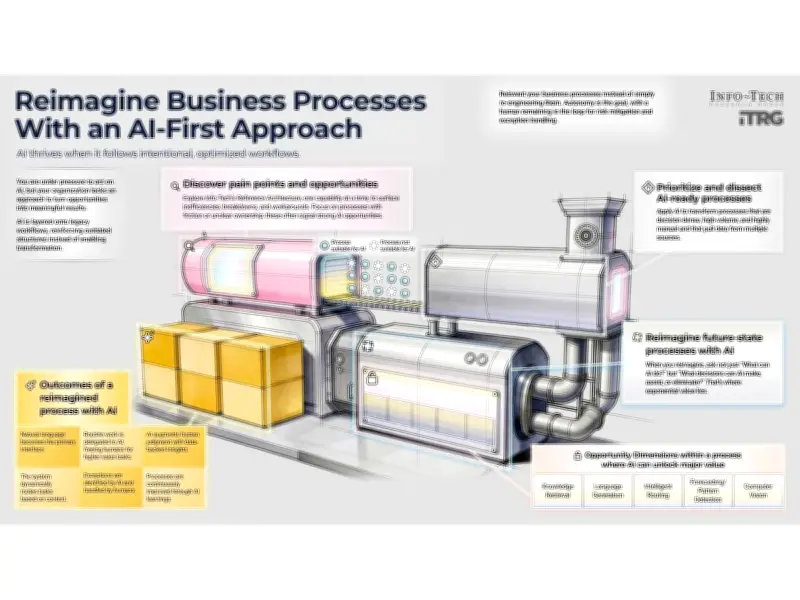
The blueprint introduces a structured methodology to help organizations move beyond ad hoc AI use cases toward intentional, AI-first process design. The three phases are:
- Phase 1: Discover Pain Points and Opportunities – Build a cross-functional working group, inventory key business processes, and assess each for AI suitability, value, and risk.
- Phase 2: Prioritize and Dissect AI-Ready Processes – Shortlist the strongest candidates for redesign, map current-state workflows, and identify bottlenecks, handoffs, decision delays, and other friction points.
- Phase 3: Reimagine Future-State Processes With AI – Apply AI opportunity dimensions, redesign the future-state workflow, assess feasibility, and document the new process using the Process Reimagination Canvas.
Overcoming Fragmented AI Experimentation
The report addresses the challenge of fragmented AI experimentation by helping organizations discover high-impact opportunities, diagnose current-state process limitations, and design future-state workflows that place AI at the core of how work is performed. Info-Tech emphasizes that without a systematic approach, AI initiatives risk delivering only marginal gains while failing to achieve the transformative outcomes that executives expect.