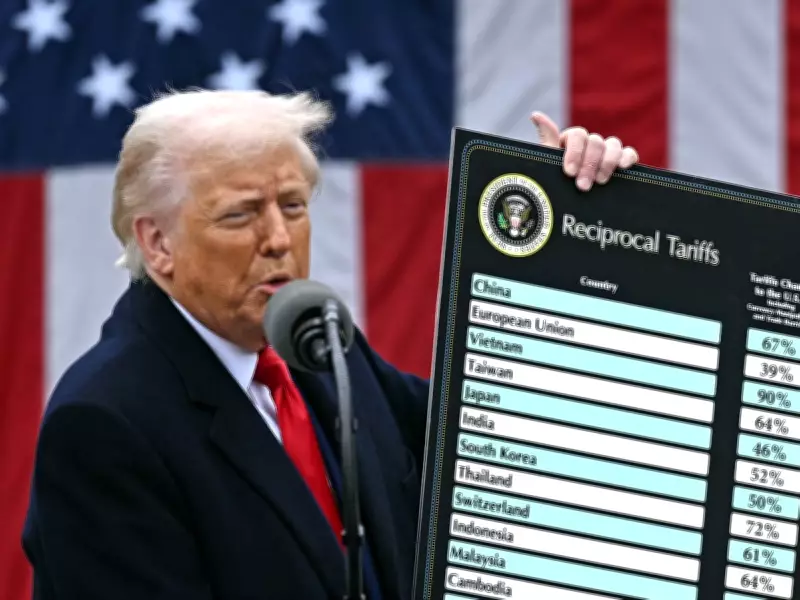
The Trump administration has requested the US trade court to pause a ruling that declared President Donald Trump's latest 10% global tariffs unlawful, allowing the government to continue collecting the levies while the appeal proceeds.
Background of the Legal Challenge
In a 2-1 decision last week, a panel of the US Court of International Trade found that Trump's use of Section 122 of the Trade Act of 1974 to impose the tariffs was invalid. However, the court's order only immediately blocked enforcement for two companies that sued and Washington state.
The government's appeal is now pending before the US Court of Appeals for the Federal Circuit. In a Monday filing, the Justice Department argued that allowing the decision to take effect would severely undermine Trump's trade agenda and divert resources from the ongoing effort to refund an earlier round of global tariffs struck down by the Supreme Court.

Impact on Importers
More than 170,000 importers have paid deposits covering new tariffs under Section 122 on 13 million entries of goods since Trump's proclamation took effect in February. US customs authorities collected roughly $8 billion in Section 122 tariffs in March alone, according to government data analyzed by We Pay the Tariffs, a coalition of small businesses.
The Justice Department warned that thousands of importers paying the tariffs were likely to flood the court with claims if the ruling stands. The government also indicated it is prepared to make an emergency request to the Supreme Court if both the trade court and the Federal Circuit refuse to pause the ruling.
Legal Arguments
The trade court rejected the administration's stance that balance-of-payments deficits, a key criteria for imposing Section 122 tariffs, was a malleable phrase. The court found that Trump's proclamation failed to identify such deficits within the meaning of the 1974 law, instead using trade and current account deficits as substitutes.
The Supreme Court earlier this year struck down Trump's global tariffs under a different law, the International Emergency Economic Powers Act (IEEPA). A refund process launched in April, but there is uncertainty about whether all companies that paid IEEPA tariffs will get their money back.
Reactions
Sara Albrecht, CEO of the Liberty Justice Center, one of the groups involved in the litigation, stated that the prospect of future refunds will never make these companies whole. She emphasized that the Court of International Trade correctly ruled the Section 122 tariffs unlawful, and the government's motion to stay that decision only prolongs uncertainty for American businesses that need stability and the rule of law.