

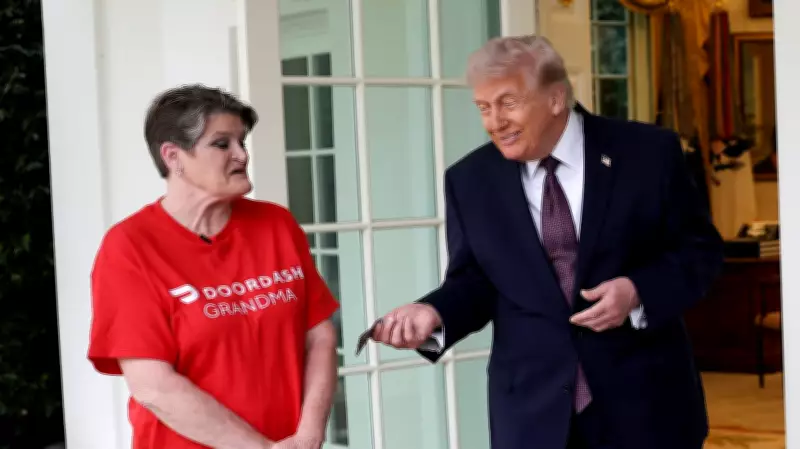
DoorDash PR Executive's Social Media Spiral Over Staged White House Delivery
In a classic case of a public relations representative needing to manage a PR disaster of their own making, DoorDash's head of public affairs, Julian Crowley, found himself in a heated social media confrontation on Monday. The backlash stemmed from a company-orchestrated publicity stunt involving President Donald Trump, which quickly spiraled into accusations of dishonesty and manipulation.
The Controversial PR Stunt
Earlier that day, DoorDash driver Sharon Simmons, a grandmother originally from Arkansas, participated in a staged event at the White House. During a press conference to promote Trump's "no tax on tips" policy, she hand-delivered McDonald's to the president. The White House touted the moment on social media, claiming the policy saved Simmons $11,000 in the past year, money she reportedly intended to use for her husband's cancer medical bills.
However, critics quickly labeled the stunt as disingenuous. They pointed out that the "no tax on tips" policy is part of the One Big Beautiful Bill Act, which also included cuts to Medicaid, adversely affecting healthcare for many Americans. Additionally, questions arose about whether Simmons' job as a driver was impacted by rising gas prices linked to Trump's policies on Iran.

Social Media Backlash and Crowley's Response
The event drew widespread skepticism on social media platform X, with users accusing the White House and DoorDash of presenting the interaction as authentic despite clear staging. Trump himself joked during the stunt, "This doesn't look staged, does it?" fueling further doubt. Matters worsened when a resurfaced video showed Simmons advocating for the same policy at a GOP-backed event in Nevada in July 2025, where she identified as a resident of Boulder City, Nevada, not Arkansas.
This led to a flood of posts alleging Simmons was a "fake," "paid actor," or "prop" for Trump's administration. Although DoorDash issued a press release confirming the event was staged to commemorate the policy's first anniversary, Crowley took it upon himself to address critics directly on X, resulting in a messy exchange.
Crowley's Defensive Tweets
In a series of tweets, Crowley insisted that no one claimed the delivery was real, describing it as a planned event to mark the policy. He vehemently denied that Simmons was a prop or actor, stating, "She is a Dasher and she participated to support the policy that benefits her." When users highlighted the Nevada testimony, Crowley argued it was plausible she had moved states and still supported the policy.
His responses grew increasingly sarcastic, telling one critic to "touch grass" and mocking others for doubting Simmons' consistency. He even corrected X's AI chatbot, Grok, which had incorrectly suggested two different women named Sharon were involved, clarifying it was the same person who had relocated from Nevada to Arkansas.
Fallout and Implications
Crowley's aggressive engagement backfired, amplifying the controversy rather than quelling it. His meltdown highlighted the challenges companies face in managing staged political events, especially in an era of heightened scrutiny on social media. The incident raises broader questions about the ethics of using individuals in PR stunts and the transparency required in corporate communications.
As the dust settles, DoorDash may need to reassess its crisis management strategies, while Crowley's handling of the situation serves as a cautionary tale for PR professionals navigating volatile online landscapes.






