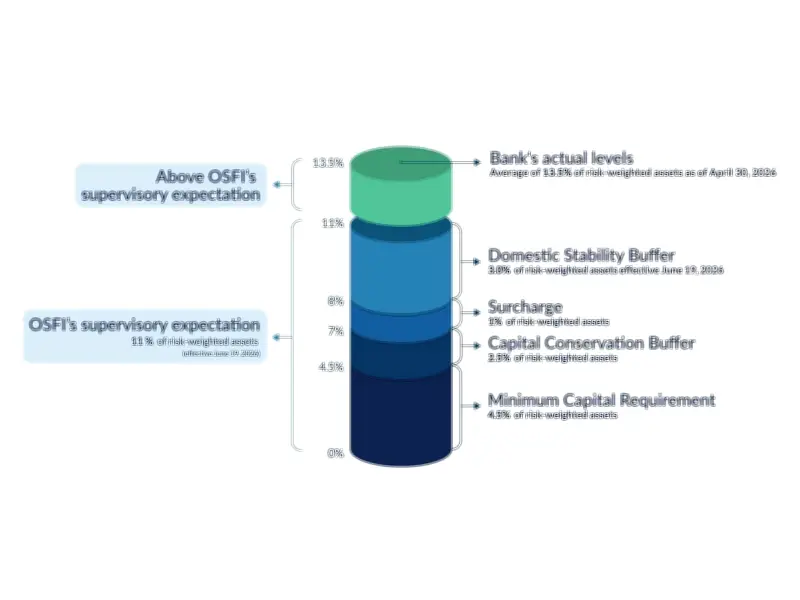
The Office of the Superintendent of Financial Institutions (OSFI) announced today that it is lowering the Domestic Stability Buffer (DSB) to 3.0% from 3.5% of total risk-weighted assets. This marks the first adjustment to the DSB since June 2023 and takes effect immediately. Additionally, OSFI is reducing the DSB range to 0 to 3% from the previous 0 to 4%.
In setting the DSB, OSFI balances the resilience benefits of holding additional capital against the financial system's ability to support economic growth and adaptation. These measured adjustments reflect the sustained strength and resilience of Canada's domestic systemically important banks (D-SIBs). These institutions have built extraordinary loss-absorption capacity to manage a range of risks, enabling them to continue lending and taking other risks to meet customer needs.
Canada's six largest banks continue to perform well and maintain resilient capital levels. Their Common Equity Tier 1 (CET1) ratios are well above the new supervisory expectation of 11.0%, averaging 13.5% across the sector. This sizable capital cushion equates to roughly $74 billion, or equivalently, an expansion in risk-weighted assets of $673 billion.

By lowering both the DSB level and the top end of its range, OSFI provides Canada's six largest banks with greater flexibility to deploy capital. These adjustments will enable the banks to aid the Canadian economy's adaptation to shifting dynamics in technology, trade, and geopolitics, with opportunities in segments such as defense and security, critical infrastructure, resources, and artificial intelligence.
Quote from Superintendent Peter Routledge
"By lowering both the level and top end of the range of the Domestic Stability Buffer, OSFI will enable the banking sector to deploy its excess capital in support of Canada's economic adaptation to new opportunities. These decisions are consistent with our risk-based, proactive approach to managing capital buffers for Canada's systemically important banks. We anticipate Canada's largest banks will use this capital release to invest in Canada's economy through this period of structural change."
Quick Facts
- The DSB applies to Canada's six largest banks, known as domestic systemically important banks (D-SIBs).
- OSFI expects D-SIBs to maintain a total Common Equity Tier 1 (CET1) ratio of at least 11.0% of risk-weighted assets. All currently exceed 13%, with an average of 13.5%.
- OSFI reviews and sets the DSB level twice a year, in June and December, and can adjust it at any time if conditions warrant.
- Decisions are based on a wide range of indicators, stress-testing results, and supervisory judgment.
More information about OSFI's decision can be found in the Decision Summary Note.