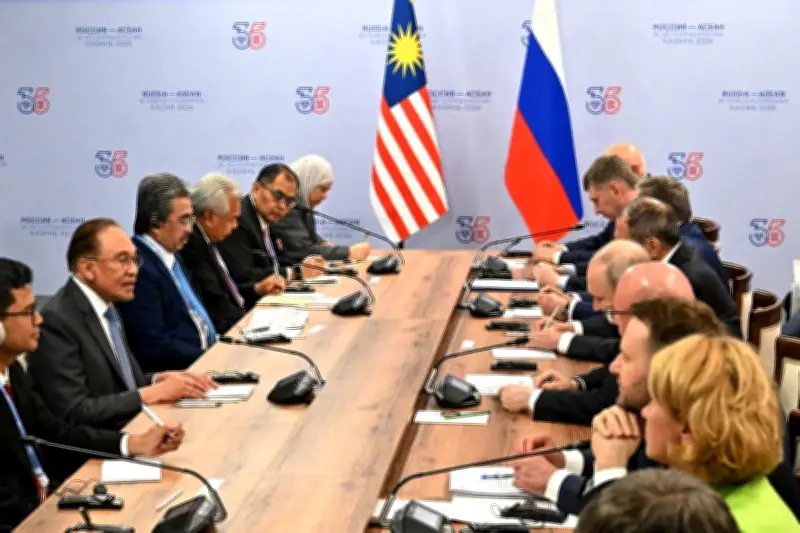
Russian President Vladimir Putin hosted leaders from Southeast Asian nations on Wednesday at the Russia-ASEAN summit in Kazan, aiming to strengthen business ties and economic cooperation. The summit, held in the city of Kazan, brought together heads of state from the Association of Southeast Asian Nations (ASEAN) to discuss trade, investment, and regional partnerships.
Key Participants and Discussions
Malaysian Prime Minister Anwar Ibrahim was among the prominent leaders attending the talks. The discussions focused on expanding bilateral trade, enhancing energy cooperation, and exploring new avenues for technological exchange. Putin emphasized Russia's commitment to deepening ties with ASEAN countries, highlighting mutual benefits in sectors such as agriculture, manufacturing, and digital economy.
Strategic Importance
The summit underscores Russia's strategic pivot towards Asia amid shifting global dynamics. With Western sanctions limiting trade with Europe, Moscow is seeking to diversify its economic partnerships. ASEAN, a bloc of 10 nations with a combined GDP of over $3 trillion, offers significant opportunities for Russian exports and investments.

During the meeting, Putin proposed joint projects in infrastructure, energy, and food security. He also called for increased cooperation in science and technology, particularly in artificial intelligence and renewable energy. ASEAN leaders expressed interest in Russian expertise in nuclear energy and space technology.
Outcomes and Agreements
Several bilateral agreements were signed on the sidelines of the summit, covering areas such as customs cooperation, educational exchanges, and tourism promotion. The leaders also discussed the implementation of the Russia-ASEAN Trade in Services Agreement, which aims to reduce barriers and boost service sector trade.
Putin reiterated Russia's support for ASEAN's centrality in regional architecture and its commitment to a peaceful resolution of disputes in the South China Sea. The summit concluded with a joint declaration reaffirming the commitment to multilateralism and free trade.
Reactions and Analysis
Analysts view the summit as a positive step for Russia's economic diplomacy. However, some experts note that practical outcomes may be limited by logistical challenges and differing regulatory frameworks. Nonetheless, the meeting signals a growing alignment between Russia and ASEAN in navigating a multipolar world order.
The summit also provided a platform for sideline meetings between ASEAN leaders and Russian business delegations, fostering direct B2B connections. Russian companies in energy, mining, and technology sectors showcased their offerings to potential partners from Southeast Asia.
Future Prospects
Both sides expressed optimism about future cooperation. Plans are underway for a follow-up summit in 2027, with an emphasis on digital transformation and sustainable development. The Russia-ASEAN Business Council will continue to facilitate trade and investment flows.
As global supply chains evolve, the partnership between Russia and ASEAN is expected to grow, offering new opportunities for businesses and consumers alike.