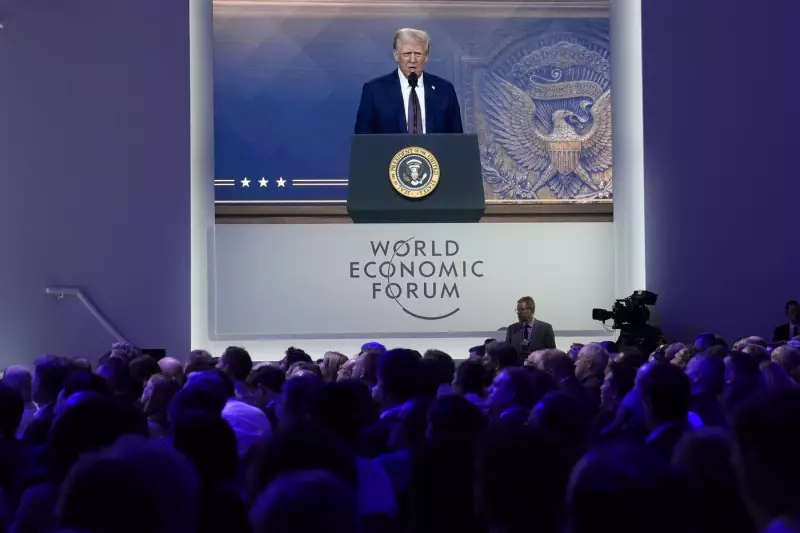
The World Economic Forum's annual meeting in Davos, Switzerland, has opened a new chapter, directly confronting a global order profoundly shaken by the political and economic reverberations of former U.S. President Donald Trump. The forum's current deliberations are set against the long shadow cast by a pivotal virtual address delivered by Trump to attendees on Thursday, January 23, 2025.
A Virtual Speech That Redefined the Dialogue
The event, now a key reference point for the 2026 gathering, featured Trump speaking remotely to the assembled global elite. His remarks, delivered via video link, challenged established multilateral norms and set a tone of economic nationalism that continues to influence international policy debates. The image of attendees listening intently to the former president's broadcast has become symbolic of the forum's adaptation to a digitized and politically fragmented world.
Navigating a Fractured Economic Landscape
Delegates at this year's meeting are tasked with building consensus in an environment still grappling with the uncertainties unleashed over a year ago. The core themes of the forum—global cooperation, trade, and climate action—are now filtered through a lens of renewed great-power competition and questioning of international institutions. The "America First" philosophy, reiterated in Trump's 2025 appearance, forced a fundamental reassessment of how global economic governance functions.

This new reality means discussions on supply chains, digital governance, and security are inherently more complex. The traditional Davos spirit of open globalization is now balanced against rising calls for economic sovereignty and reshoring, trends given significant momentum by the political shift in the United States.
The Lasting Impact on Global Forums
The 2025 virtual intervention demonstrated that influential political figures can shape the global agenda without being physically present, a precedent that may alter how future forums are conducted. More importantly, it cemented Davos as a central arena where the clash between populist nationalism and globalist cooperation plays out in real-time.
As leaders and CEOs convene in the Swiss Alps, the unspoken question hanging over the conference is how to forge a stable path forward when the rules of the past decade are no longer guaranteed. The forum's challenge is no longer just predicting economic trends but managing the political shocks that increasingly define them.