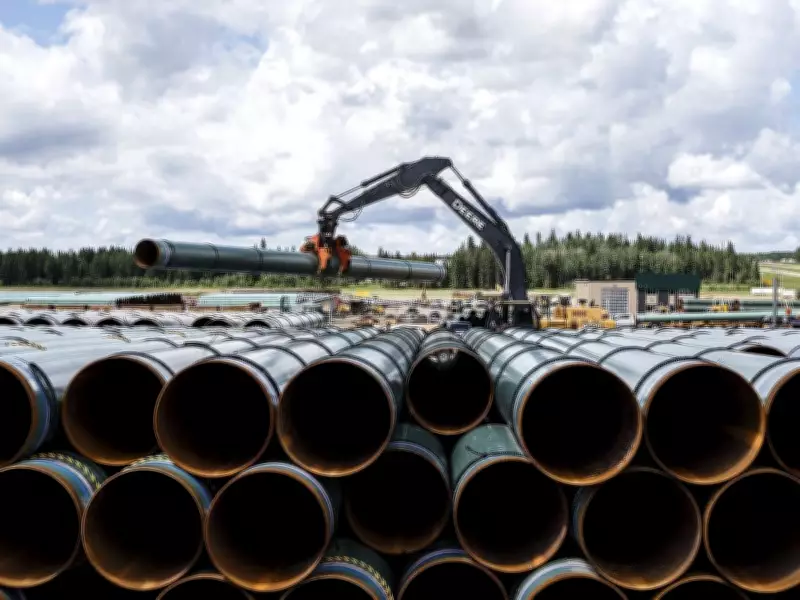
The recent military actions involving the U.S. and Israel against Iran, coupled with a dramatic spike in oil prices, have starkly reaffirmed a critical reality: oil continues to command the global energy landscape and is projected to do so for many decades ahead. This situation serves as a powerful reminder of the strategic importance of energy infrastructure, particularly for resource-rich nations like Canada.
Canada's Energy Potential and Current Constraints
Canada stands as the world's fourth-largest producer and exporter of oil, boasting the fourth-largest reserves estimated at a staggering 163 billion barrels, trailing only Saudi Arabia, Venezuela, and Iran. Despite this immense wealth, the country faces significant economic drawbacks. Currently, Canada sells much of its oil at substantial discounts to the United States, primarily due to inadequate pipeline capacity to reach tidewater and, subsequently, global markets. This limitation makes little economic sense, effectively leaving vast resources undervalued and underutilized.
In 2024, oil supplied 30.6% of global energy needs, while renewable sources like wind and solar contributed a mere 3.5%. This disparity highlights the ongoing reliance on fossil fuels, even as the world transitions toward cleaner energy. A key strategy in this shift involves replacing coal-fired electricity, which accounts for 26.5% of global energy, with natural gas. Natural gas, supplying 22.7% of global energy, burns at half the carbon dioxide intensity of coal, offering a more practical and effective pathway to a cleaner energy supply.

Progress and Hurdles in Energy Export Projects
Canada is also the fifth-largest producer and fourth-largest exporter of natural gas, yet it encounters similar challenges. The lack of access to global markets forces the sale of most natural gas at deep discounts to the U.S. Recent developments, such as the Trans Mountain Expansion (TMX) pipeline and LNG Canada facility, have begun shipping limited quantities of oil and liquefied natural gas to international markets beyond the U.S. since May 2024 and June 2025, respectively. However, these initiatives represent only initial steps.
Prime Minister Mark Carney has emphasized the need for Canada to accelerate its pace, moving at speeds "not seen in generations" to become an energy superpower. His government plans to fast-track nation-building projects, including a new pipeline from Alberta's oilsands to tidewater in British Columbia, under a memorandum of understanding with Alberta Premier Danielle Smith.
Potential Obstacles to Pipeline Development
Despite these ambitions, several significant barriers could impede progress. Key challenges include:
- Canada's industrial carbon tax, which may affect project economics.
- Opposition from the British Columbia government, creating political friction.
- Unclear definitions of "consent" from Indigenous nations, complicating consultations and approvals.
- The need to amend federal legislation, such as the oil tanker moratorium act, to facilitate exports.
These factors collectively generate uncertainty for private sector investors, whose financing is crucial for such large-scale infrastructure projects. Without clear resolutions, Canada's ability to fully leverage its energy resources and compete on the global stage remains constrained, underscoring the urgent need for strategic policy adjustments and collaborative efforts.