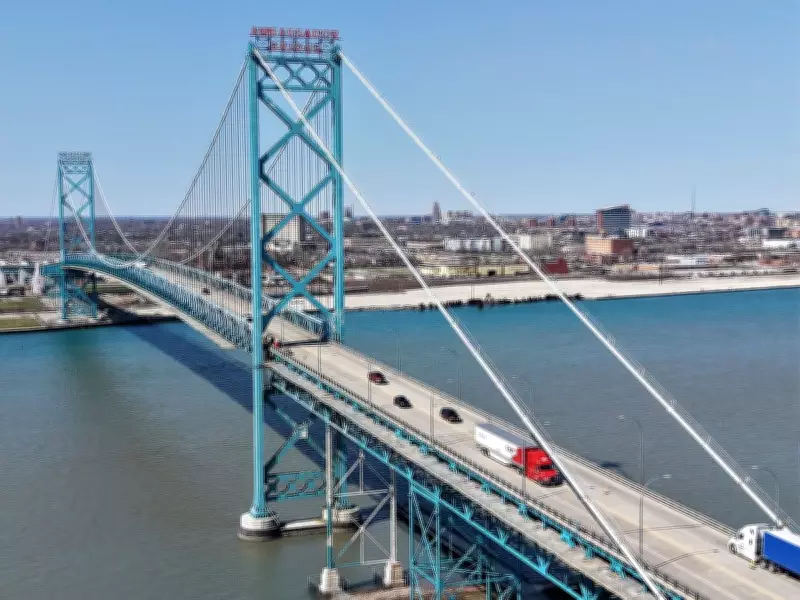
Ambassador Bridge Dethroned as Busiest U.S.-Canada Trade Crossing
The Ambassador Bridge's long-standing reign as the busiest trade crossing between Canada and the United States has officially ended. New data reveals a dramatic shift in cross-border freight patterns, with the Blue Water Bridge in Sarnia emerging as the new leader in commercial truck traffic.
A Major Shift in Cross-Border Freight Flow
According to statistics from the Bridge and Tunnel Operators Association, the Blue Water Bridge handled approximately 2,132,839 commercial trucks last year, while the Ambassador Bridge saw only 1,858,824 trucks. This represents a difference of roughly 274,000 more trucks crossing at Sarnia, signaling a substantial change in how international freight moves between the two nations.
The trend has continued into 2026, with the Blue Water Bridge maintaining its dominance. During the first two months of this year, the Sarnia crossing recorded 299,611 truck crossings compared to the Ambassador Bridge's 286,992.

Toll Disparities Drive the Change
Industry experts point to significant toll differences as the primary factor behind this traffic shift. The Blue Water Bridge, owned by the Federal Bridge Corporation Limited (a Crown corporation), charges commercial trucks just $7 per axle.
In stark contrast, the privately owned Ambassador Bridge currently charges up to $27 per axle for trucks without an A-Pass or E-ZPass, and approximately $20 per axle for those with passes.
"The trucking industry, and particularly the trucking supply chain, is highly competitive. Companies strictly manage costs to stay competitive," explained Stephen Laskowski, president and CEO of both the Canadian Trucking Alliance and the Ontario Trucking Association.
"Obviously, a great number of companies did their own calculations," Laskowski added, noting that this led to a "significant shift" in commercial traffic toward the Blue Water Bridge. "It appears the cost differential between the bridges outweighed the extra kilometres in fuel."
Implications for Future Cross-Border Infrastructure
The upcoming opening of the Gordie Howe International Bridge in Windsor this spring adds another dimension to this evolving landscape. When operational, large commercial vehicles will be charged $12 per axle on the new bridge, with vehicles having a "Breakaway" account paying $9.60 per axle.
Drivers with Breakaway accounts and vehicle tags will also benefit from open toll lanes that allow passage without stopping, potentially offering greater efficiency than current crossing options.
"There's an expectation that if you have more efficient infrastructure, that you will draw traffic," said Marta Leardi-Anderson, executive director of the Cross-Border Institute. "It's understanding how you optimize the infrastructure to provide a crossing that's more of a rolling over the border versus a stop, stop, stop. This has been the criticism about the Ambassador Bridge for years."
The Ambassador Bridge company did not respond to requests for comment regarding these developments and the traffic shift.
This changing dynamic in cross-border trade infrastructure represents a significant realignment in North American supply chains, with cost considerations and operational efficiency driving commercial decisions that reshape decades-old traffic patterns.