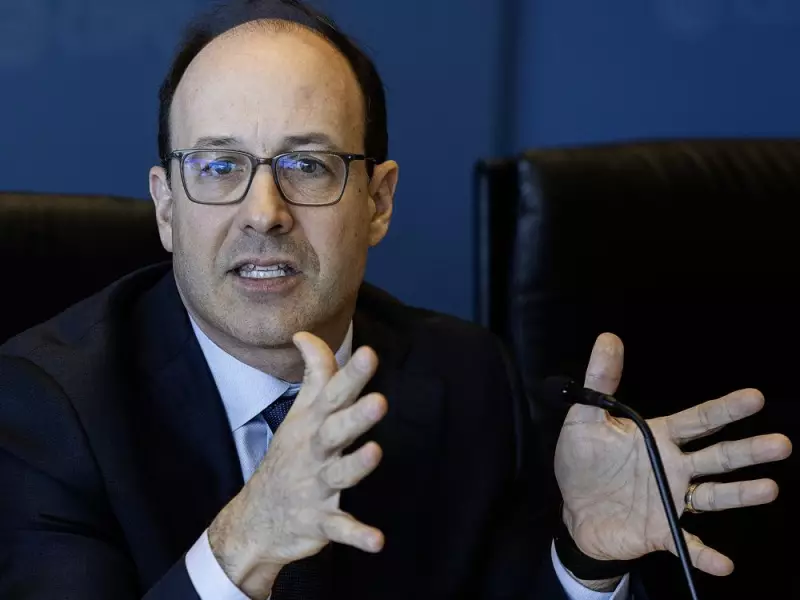
The chief executive of one of Canada's largest pension funds asserts that a pivotal shift is underway, with institutional investors and the federal government finally aligning to advance multi-billion-dollar national projects. Charles Emond of the Caisse de dépôt et placement du Québec credits the impending renegotiation of the Canada-U.S.-Mexico Agreement (CUSMA) in 2026 for galvanizing this new era of cooperation.
A Convergence of Interests on Major Projects
Emond, who leads the $496-billion Quebec pension fund, observed a significant change in dynamics. "The government is actually getting more synchronized with what private investors are looking for," he stated. "You can sense a momentum. That is a big difference from before." This alignment is focused on priority areas including national infrastructure, critical minerals development, and housing.
The federal government, under Prime Minister Mark Carney, is actively seeking to "catalyze" hundreds of billions in private investment. This strategy aims to supplement public spending on projects designed to boost economic growth and reduce over-reliance on the United States. Emond believes the looming CUSMA talks are a powerful motivator for both sides to find workable models for these large-scale deals.

From Ports to High-Speed Rail: A Pipeline of Opportunities
The Caisse is already involved in key nation-building initiatives. It is participating in the expansion of the Port of Montreal, one of five projects fast-tracked by the federal government in September 2025. Furthermore, the fund's infrastructure arm is part of a consortium co-developing a high-speed rail line connecting Toronto and Quebec City in partnership with Ottawa.
Emond revealed that this is just the beginning. "We've got a pretty big pipeline of several projects in the tens of billions (of dollars), whereby we hope to be able to actually keep pushing the dialogue and get something going," he said. He confirmed ongoing discussions with the federal government regarding significant projects in or running through Quebec, spanning critical minerals, housing, and transportation.
A Framework for Future Mega-Deals
The shift follows a decade of largely unsuccessful attempts by Ottawa to attract private capital into its priority projects. The landscape changed in 2025, as a wave of U.S. tariffs and economic threats prompted Canadian pension executives to openly discuss increasing domestic investments. Emond points to the federal government's clearer roadmap as a turning point.
This framework includes five priority areas and the establishment of a centralized Major Projects Office. Emond suggests this structure could eventually facilitate domestic investments on the scale of the Caisse's $3.2-billion commitment to a £38 billion nuclear project in the United Kingdom. That overseas investment was driven by the UK's energy security needs, a parallel to Canada's own strategic imperatives.
The new alignment marks a departure from recent tensions, where pension funds pushed back against government pressure to invest more at home. Now, with the CUSMA renegotiation on the horizon, a collaborative push for major Canadian projects appears to be gaining real traction.