Prime Minister Mark Carney told the CBC that he is in no hurry to sign a minor tariff relief deal with the United States, arguing that other governments that have rushed into such agreements are dissatisfied with the outcomes. In an interview aired Monday, Carney stated, “A lot of countries rushed into deals with the U.S.. They weren’t really worth the paper they were written on.”
Carney noted that in private, other countries’ leaders are “certainly not” happy with the agreements they signed to reduce U.S. President Donald Trump’s sweeping tariffs on their goods, though he declined to name specific nations. Trump has threatened to alter some deals after signing them, such as a pact with the United Kingdom.
Unlike many countries, a large majority of Canadian goods currently enter the U.S. tariff-free thanks to an exemption under the Canada-U.S.-Mexico Agreement (CUSMA) signed by Trump in 2020. Canada is a major supplier of oil, fertilizer, and other raw materials to the U.S., and imposing import taxes on these would exacerbate U.S. inflationary pressures.

However, high U.S. tariffs on foreign autos, steel, aluminum, and lumber are impacting Canada’s economy and causing job losses due to the interconnected nature of these industries with the U.S. market. Carney told the CBC he does not want to strike an imperfect “small deal that disadvantages us” merely to obtain relief in those sectors.
“We could sit down this afternoon and hammer the whole thing out over the course of 10 days if the U.S. side — which has other things to do, I acknowledge that — had the bandwidth and the inclination to go through it,” Carney said. “But it takes two to negotiate it through, and they’re not all the way there.”
Carney’s interview comes days after senior U.S. and Canadian officials exchanged public updates on the obstacles each side perceives as they approach a scheduled review of CUSMA. U.S. Trade Representative Jamieson Greer threatened unspecified “enforcement action” because Canadian provinces removed U.S. alcohol from state-run liquor stores in retaliation for U.S. tariffs. Commerce Secretary Howard Lutnick also criticized Canadian limits on dairy imports.
Carney fired back last week, calling U.S. tariffs a violation of the 2020 trade deal. His new chief trade negotiator said Canada wants the White House to recognize that Canada has already made concessions, such as removing a digital services tax at Trump’s request.
There has been little public progress in Canada-U.S. tariff talks since October. The two countries were close to a limited deal on metals before Trump terminated negotiations, citing an anti-tariff television commercial from the province of Ontario that quoted former U.S. President Ronald Reagan.
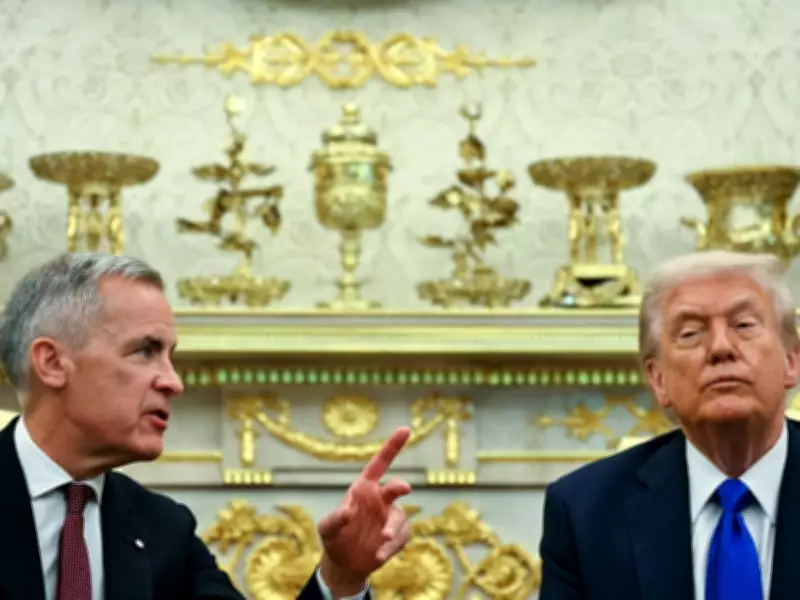
Carney said there is no doubt that the final decision on trade issues rests with one man. “He’s the decision-maker, full stop, on these issues and all other issues,” the prime minister said of Trump.