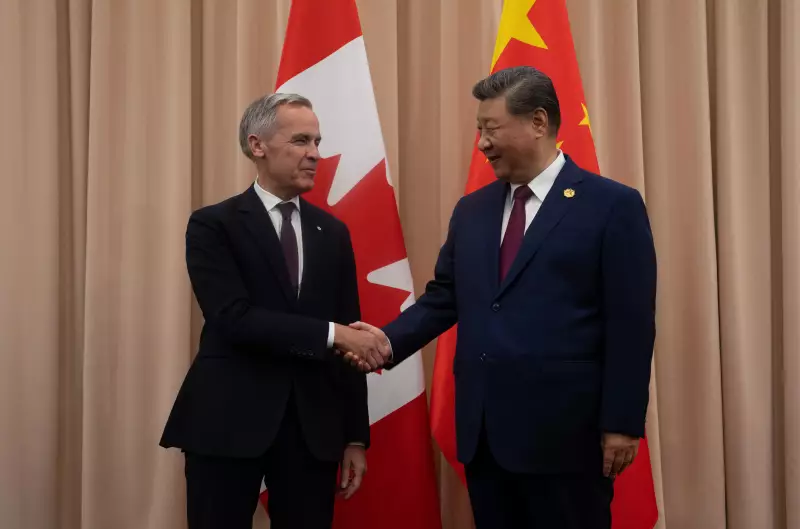
Prime Minister Mark Carney touched down in Beijing on Wednesday, January 14, 2026, initiating a significant trade mission aimed at mending and strengthening economic ties between Canada and China. The visit, which includes a planned meeting with Chinese President Xi Jinping, comes at a critical juncture for key Canadian export sectors facing substantial trade barriers.
High-Stakes Economic Diplomacy on the Agenda
The Prime Minister's agenda is dominated by pressing commercial issues. Canadian farmers are anxiously awaiting progress on the removal of Chinese tariffs on canola, a long-standing point of contention that has severely impacted the agricultural sector. Simultaneously, the Canadian government is seeking clarity and potential exemptions from recent steep tariffs imposed by China on electric vehicles (EVs), a move that threatens a growing industry.
Beyond defensive measures, Carney's mission also has an offensive component: attracting capital. The Prime Minister is actively courting Chinese private sector investment into Canadian projects and industries, looking to bolster economic growth and infrastructure development back home.

Domestic Context: Balancing Priorities
Carney's departure for Asia followed a series of important domestic engagements. Just prior to the trip, he met with leaders of Coastal First Nations in British Columbia. This meeting was crucial to address ongoing concerns and pushback from Indigenous communities regarding major resource and infrastructure projects, underscoring the government's need to balance international ambitions with domestic reconciliation and consent.
The trade mission to China represents a delicate diplomatic dance. Analysts suggest Carney must navigate a complex geopolitical landscape, advocating fiercely for Canadian economic interests while managing a bilateral relationship that has seen its share of tensions in recent years. The outcomes on canola and EVs will be immediate benchmarks for the mission's success.
What Success Would Look Like for Canada
A breakthrough on canola tariffs would provide immediate relief to Prairie farmers and restore a vital export channel. Progress on EV tariffs would offer stability and growth potential for Canada's burgeoning electric vehicle and battery supply chain. Securing commitments for new Chinese investment could funnel capital into sectors like clean technology, resources, and infrastructure.
As meetings get underway in Beijing, the Canadian business community and agricultural sector will be watching closely. The Prime Minister's ability to secure tangible concessions will define this trade mission and set the tone for Canada-China economic relations for the foreseeable future. The visit marks a proactive step by the Carney government to engage directly with one of the world's largest economies on the most pressing issues facing Canadian exporters.