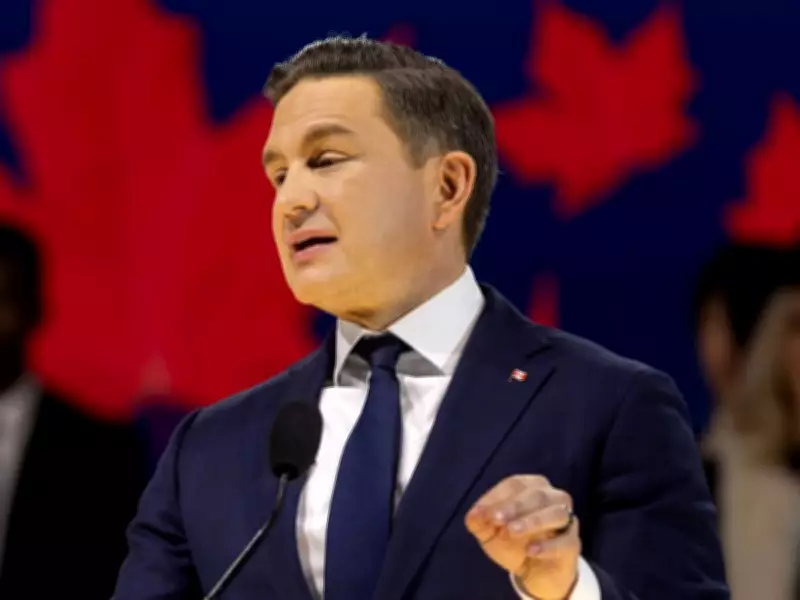
Conservative Leader Pierre Poilievre has issued a stark warning that China cannot serve as a substitute for the United States in Canada's economic and strategic partnerships. In a speech delivered to business leaders at the Economic Club of Canada in Toronto, Poilievre rebuked Prime Minister Mark Carney's recent diplomatic outreach to Beijing, emphasizing that Canada's prosperity and security remain inextricably linked to stable relations with its southern neighbor.
Rejecting a Strategic Shift to Beijing
Poilievre's remarks represent his most comprehensive statement to date on navigating trade tensions with the United States, particularly as polls indicate Canadians view the Carney Liberals as better equipped to manage relations with the Trump administration. "Canada's prosperity and security are inseparable from a stable relationship with the United States," Poilievre asserted in prepared comments. He criticized the notion of declaring a permanent rupture with the U.S. in favor of a strategic partnership with Beijing, noting that Carney himself had previously identified China as the biggest threat to Canada.
Trade War Approach and Tariff Demands
Outlining his party's distinct approach to the ongoing trade war, Poilievre called for an end to President Trump's sector-specific tariffs on steel, aluminum, automobiles, and lumber. With a review of the Canada-U.S.-Mexico Agreement approaching, he positioned this demand as a critical step toward restoring economic stability. Additionally, Poilievre proposed a novel "tariff-free auto pact" under which Canada would agree to exclude Chinese vehicles from its market if the United States permits Canadian vehicles to enter tariff-free.

This proposal comes against a backdrop of escalating trade measures. In 2024, Canada joined the U.S. in imposing 100 percent tariffs on Chinese electric vehicles, only for Trump to later extend tariffs to Canadian cars. In January, Carney reached an agreement with President Xi Jinping to lower tariffs on 49,000 Chinese EVs annually in exchange for China easing duties on Canadian agricultural products—a move Poilievre implicitly criticized.
Broader Economic and Infrastructure Initiatives
Beyond tariffs, Poilievre advocated for a full exemption from "Buy America" rules and the relaunch of the Keystone XL pipeline project. South Bow Corp. has recently indicated it is considering an expansion of its pipeline system that could revive a version of the project, which was cancelled by the Biden administration. Poilievre framed these efforts as part of a broader strategy to strengthen Canada's domestic economy by enhancing resource market access, accelerating home construction, bolstering military capabilities, and protecting digital sovereignty.
Political Context and Competing Visions
The speech coincided with a scheduled address by Dominic LeBlanc, the minister responsible for Canada-U.S. trade, who spoke about bilateral relations at the Canadian Club Toronto. Poilievre's vision contrasts sharply with Carney's framing of the shifting geopolitical landscape—including Trump's trade and foreign policies—as a rupture affecting Canada and the global community, a theme Carney highlighted in his Davos speech last month.
Poilievre's emphasis on prioritizing the U.S. relationship over Chinese partnerships underscores a deepening political divide on trade policy. As Canada prepares for potential negotiations and reviews of key agreements, his proposals aim to redirect focus toward domestic economic resilience and reinforced ties with the United States, challenging the current government's strategic calculus.