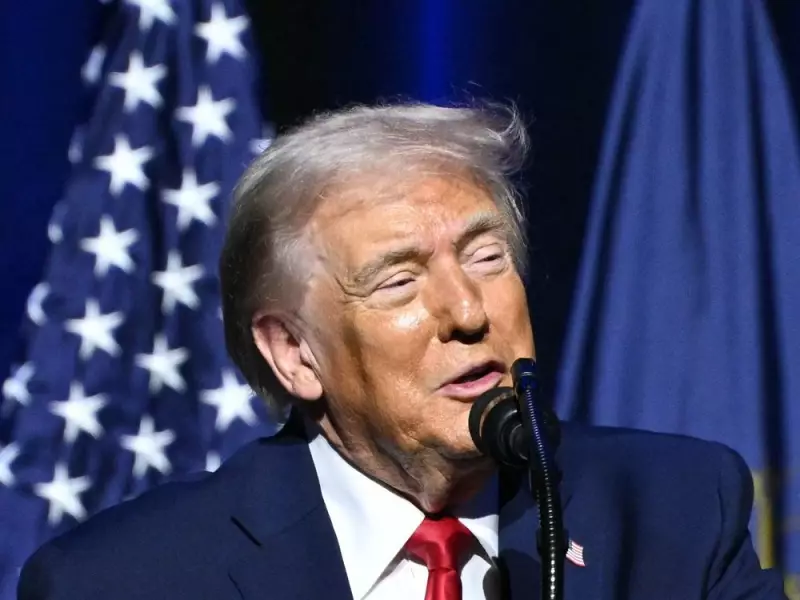
Former U.S. President Donald Trump has publicly dismissed the landmark North American trade agreement he once championed, declaring the Canada-United States-Mexico Agreement (CUSMA) to be of little consequence to the United States. This stark reversal signals a looming and potentially protracted renegotiation of the continent's most critical economic pact, directly threatening stability for Canadian and Mexican exporters.
A Deal in the Crosshairs
During a visit to a Ford Motor Co. plant on Tuesday, Trump was questioned about his intentions for the trade deal, which is scheduled for a mandatory review this year. His response was blunt and dismissive. "We could have it or not, it wouldn't matter," Trump told reporters. "It's irrelevant." He further claimed the pact, also known as USMCA, offers "no real advantage" to the U.S. and primarily benefits Canada, arguing Americans "don't need their product" because "everybody's moving here."
When pressed on whether he still wants the agreement, Trump shifted focus to America's neighbours, stating, "I think they want it. I don't really care." He elaborated, "I don't even think about USMCA. I want to see Canada and Mexico do well. The problem is we don't need their product. You know, we don't need cars made in Canada. We don't need cars made in Mexico. We want to make them here."

Renegotiation Looms, Creating Uncertainty
These comments represent the latest warning shot to officials in Ottawa and Mexico City, who have navigated Trump's unpredictable trade policies since his return to office a year ago. The 2026 review is a built-in feature of the agreement Trump signed in 2020, which replaced the NAFTA pact he frequently criticized. The process requires all three nations to agree to renew CUSMA before July 1, 2026, to secure a 16-year extension.
Failing that agreement, the countries must conduct annual joint reviews until they approve the pact again or it expires in 2036. Separately, the agreement allows any country to exit with six months' written notice, a power Trump could choose to exercise. The uncertainty over his strategy has injected significant tension into the review, as the collapse of CUSMA would devastate deeply integrated supply chains, particularly in the auto manufacturing sector, and deliver a severe blow to the Canadian and Mexican economies.
A Pattern of Pressure Tactics
Trump's recent derision of CUSMA appears to be a tactical move to gain leverage. In recent months, he has already tested the pact's stability by imposing and then scaling back new tariffs on Mexican and Canadian goods, initially justifying them as a measure against fentanyl trafficking before exempting CUSMA-covered products.
This pattern suggests the scheduled renegotiation could quickly become a forum for airing U.S. grievances. For Canada, a nation for which the United States is the overwhelming dominant trading partner, the prospect of the agreement unravelling represents a profound economic threat. The comments underscore a volatile road ahead for North American trade relations, with the stability of a deal once hailed as a signature achievement now hanging in the balance.