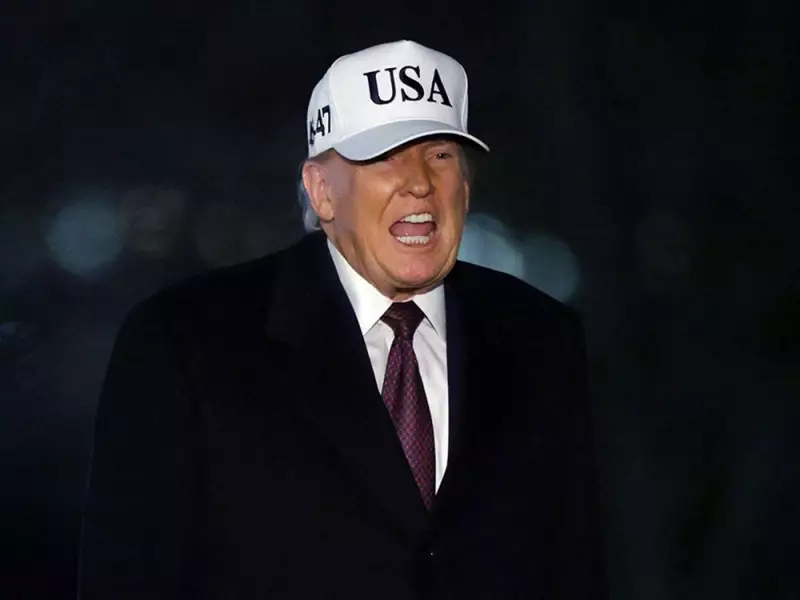
Former U.S. President Donald Trump issued a stark warning this week, declaring the United States would be "screwed" if the Supreme Court rules that key portions of his tariff policies are illegal. The high-stakes legal battle, which saw oral arguments in November 2025, centers on Trump's expansive use of presidential emergency powers to levy sweeping tariffs.
Trump's Dire Financial Warning on Truth Social
In a post on his Truth Social platform on Monday, January 12, 2026, Trump framed the potential ruling as a catastrophic financial liability. He argued that a decision against his administration's tariffs could force the U.S. to pay back "hundreds of billions of dollars" to American companies that paid the duties.
Trump further contended that the financial fallout would extend far beyond direct repayments. "And that doesn’t include the amount of ‘payback’ that Countries and Companies would require for the investments they are making… for the purpose of being able to avoid the payment of Tariffs," he wrote. He estimated the total cost, when including these redirected investments, would reach into the trillions of dollars, calling it a "complete mess" and "almost impossible for our Country to pay."

His post concluded with the blunt assessment: "In other words, if the Supreme Court rules against the United States of America on this National Security bonanza, WE’RE SCREWED!"
Supreme Court Skepticism During Oral Arguments
The Supreme Court is poised to release opinions, potentially as soon as Wednesday, and the tariffs case is among the pending decisions. During the November hearings, justices from across the ideological spectrum expressed deep doubt about the legal foundations of Trump's tariff strategy.
The case challenges Trump's invocation of the International Emergency Economic Powers Act (IEEPA) to impose "reciprocal" tariffs on nearly all U.S. trading partners. Additional levies targeting Mexico, Canada, and China were justified by their alleged roles in illicit drug trafficking. Multiple justices, including several of the court's six conservatives alongside its three liberals, questioned whether the IEEPA—a law designed for national emergencies—grants the president authority to unilaterally set broad tariff rates.
It is important to note that this specific case does not address other sector-specific tariffs Trump imposed on goods like steel, aluminum, and automobiles.
Political and Economic Repercussions
The outcome carries significant weight for both the U.S. economy and Trump's political future. His policies have driven the average effective U.S. tariff rate to its highest level since the 1930s. Trump has consistently argued these measures are vital for national security and economic fairness, while critics blame them for contributing to persistent inflation.
This political pressure is evident in polling, which has shown a decline in Trump's approval rating over the past year, partially attributed to economic concerns linked to the tariffs. The Supreme Court's decision will not only determine the legality of a cornerstone policy but could also reshape the boundaries of presidential power in international trade for years to come.