

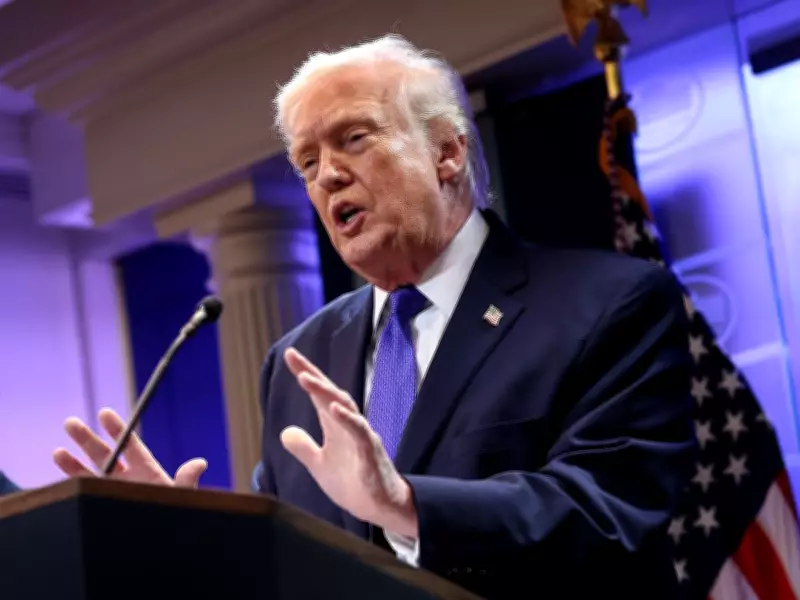
Trump's Tariff Threats Against Canada Intensify Following Supreme Court Ruling
A recent U.S. Supreme Court decision has delivered a significant blow to President Donald Trump's unilateral tariff powers, yet the economic pressure on Canada appears far from over. The 6-3 majority ruling on February 20, 2026, declared that Trump's use of the International Emergency Economic Powers Act (IEEPA) to impose tariffs was unconstitutional, affirming that such authority rests solely with Congress. This decision has reduced average posted tariff rates from approximately 16 percent to around 7 percent, marking a legal victory for constitutional principles.
Legal Setback Fails to Deter Presidential Ambitions
Despite this judicial rebuke, Trump has signaled an unwavering commitment to his protectionist agenda. In a social media post following the ruling, he emphasized that numerous other tariffs remain legally intact and can be deployed "in a much more powerful and obnoxious way." This ominous declaration suggests that the president views the court's decision not as a defeat but as a clarification that could enable more aggressive trade actions with greater legal certainty.
The immediate financial repercussions for the U.S. government are substantial, with billions of dollars collected from importers under the IEEPA now potentially subject to refunds. However, Trump's rhetoric indicates a strategic pivot rather than a retreat, with Canadian industries squarely in the crosshairs of future economic measures.

Canadian Industries Face Ongoing Vulnerability
Michael Gregory, deputy chief economist at BMO Capital Markets, highlighted in a research note that national security tariffs under Section 232 of the U.S. Trade Expansion Act remain unaffected by the Supreme Court's decision. This means existing duties on steel, aluminum, autos and parts, copper products, lumber, wood products, trucks, and buses will continue unabated, maintaining significant pressure on key sectors of the Canadian economy.
The impact has already been devastating. Canadian auto manufacturing experienced a 5.4 percent year-over-year decline as carmakers idled plants and shifted production southward. Although the 25 percent tariff under Section 232 was partially mitigated by CUSMA-compliant parts exemptions, the effective rate on Canadian-produced autos remained at 15-20 percent—higher than those imposed on the European Union, Japan, or South Korea.
TD Economics forecasts an additional four percent decline in production this year, contingent upon the renewal of CUSMA exemptions. This troubling trend underscores the fragility of Canada's manufacturing sector in the face of sustained U.S. trade aggression.
Expanding Threat to Additional Sectors
The Trump administration has conducted nine industry investigations—completed or pending—without announcing tariff recommendations. Gregory suggests these were deliberately held back pending the Supreme Court's decision, indicating a potential barrage of new sectoral duties is imminent. Industries already investigated include semiconductors, pharmaceuticals, processed critical minerals, commercial aircraft, and jet engines.
Ongoing studies target polysilicon (essential for solar panels), drones, wind turbines, medical equipment, and robotics. According to a report from the Council on Foreign Relations, approximately US$156 billion of Canadian exports are covered by existing or potential Section 232 tariffs, representing a substantial portion of the bilateral trade relationship.
Gregory noted that Trump has already referenced potential tariffs on commercial aircraft due to perceived delays in Canadian certification of Gulfstream jets. "In all likelihood, the only reason he felt he had the ability to do that was because the study was already done," Gregory stated, illustrating how preemptive investigations provide the administration with ready-made justifications for future trade actions.

Broader Implications for Canada-U.S. Relations
The Supreme Court's decision reaffirms the constitutional separation of powers in the United States, but it does little to alleviate the economic uncertainty facing Canada. With Trump demonstrating a tank-like persistence—devoid of reverse gears—the prospect of escalating trade tensions looms large. Canadian policymakers and industry leaders must prepare for a scenario where legal victories in Washington translate into continued economic challenges at home.
As the administration prepares to unleash its tariff ammunition, the resilience of Canada's export-dependent economy will be tested. The coming months may determine whether diplomatic channels can mitigate the damage or if further deterioration in trade relations is inevitable.





