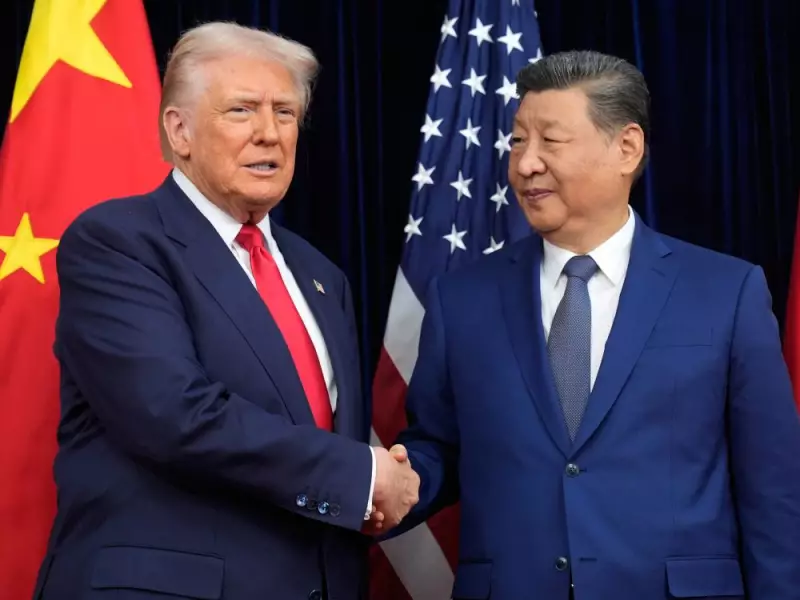
Following a brief meeting between U.S. President Donald Trump and Chinese President Xi Jinping in South Korea in late October, analysts have concluded that the resulting agreement did little more than reset the trade relationship to its previous state. This outcome is widely seen as a significant setback for President Trump's aggressive protectionist agenda.
Playing by Authoritarian Rules is a Losing Game
The failure of this strategy should come as no surprise. The United States built its wealth and global power as a predominantly free nation, where individual choices and market forces drive the economy. In stark contrast, China operates as a top-down state where government mandates control economic activity. By imposing tariffs and other trade restrictions, the current U.S. administration, much like its predecessors, is attempting to compete using authoritarian rulebook. China is unlikely to be defeated at its own game.
As Scott Lincicome, a trade expert from the Cato Institute, pointed out after the meeting, "Recent U.S. isolationism has helped tilt the global balance of power toward China and away from the United States." He emphasized that despite the size of the American market, the U.S. holds a relatively small share of world trade and lacks the necessary leverage to unilaterally force a restructuring of the global economy.

A Deal That Reinforces the Status Quo
The specifics of the deal reveal its shortcomings. The agreement largely consisted of China suspending the export controls and retaliatory tariffs it had imposed in response to earlier U.S. tariffs. In return, the U.S. agreed to reduce those same trade barriers. Lincicome noted that many of the terms are only a temporary return to the status quo of summer 2025, not a substantial resolution of the deep-seated issues in the U.S.-China relationship.
This arrangement also undermines a key goal of Trump's trade policy: shifting manufacturing from China to other nations more aligned with Western interests. Lincicome observed that China now faces tariffs that are only slightly higher—or in the case of India, much lower—than those imposed on the very countries that were supposed to benefit from a tougher U.S. stance on China.
Xi Jinping Emerges as the Clear Winner
The perception of the meeting's outcome strongly favored the Chinese leader. As reported by the Wall Street Journal's Josh Chin and Meridith McGraw, Xi Jinping appeared to come out of the meeting with a strong hand. This assessment was echoed by major news outlets, with both CNN and the New York Times explicitly naming Xi as the victor in these negotiations.
This dynamic is rooted in a fundamental structural difference. China is an authoritarian state with a government-driven economy, ruled by the Chinese Communist Party. President Xi does not face the same pressures as a democratic leader; he doesn't have to answer to voters or defend his economic policies in court. This gives him a natural advantage when implementing trade barriers that may harm the public or controlling sectors of the economy that are typically left to market forces.
President Trump has long championed a version of the "American system"—a historical approach favoring high tariffs, centralized banking, and government-directed infrastructure, as promoted by figures like Henry Clay and President William McKinley. His particular focus has been on using trade barriers to protect and promote domestic industries. However, this analysis suggests that this system was never as effective as its proponents claimed, and attempting to revive it to counter modern China is a flawed strategy that concedes the home-field advantage to an authoritarian opponent.