A recent survey indicates Canadian businesses are approaching the first half of 2026 with tempered hiring expectations, as a persistent skills shortage and technological evolution create significant challenges.
Cautious Hiring Plans for the New Year
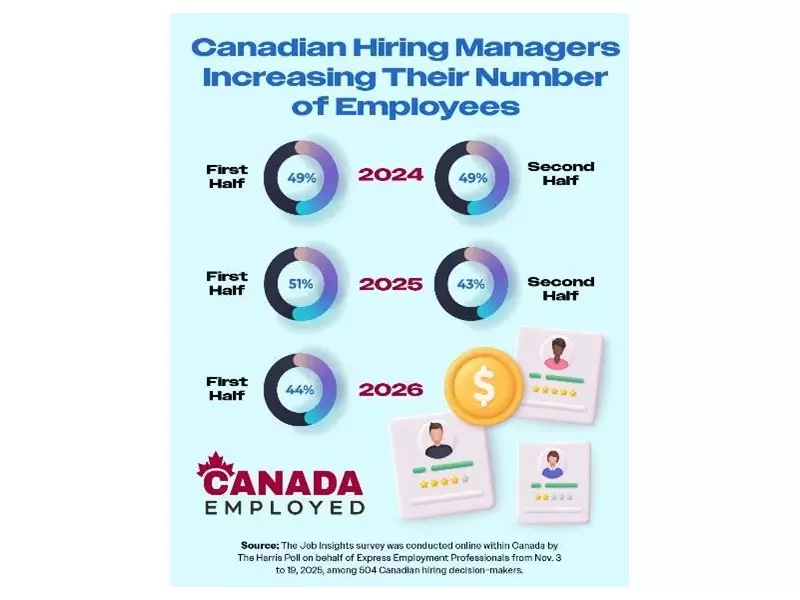
According to a survey by Express Employment Professionals and Harris Poll released in late December 2025, only 44% of companies plan to increase their headcount in the first six months of 2026. This marks a notable decline from 51% who had similar plans for the first half of 2025 and 49% in early 2024.
While a majority of firms (67%) still use positive language to describe their hiring outlook, this figure has dipped from 71% last year. Notably, a quarter of all companies characterize their approach for the year ahead as "cautious." Meanwhile, 42% of businesses intend to maintain current staffing levels, and 10% plan to decrease their workforce.

Drivers of Hiring and Staffing Reductions
For those companies looking to grow their teams, the primary motivator remains managing an increased volume of work (55%). Other key reasons include filling newly created positions (38%) and addressing employee turnover (36%). A strategic shift is also evident, with 29% of hiring aimed at acquiring new skill sets and 24% focused on expanding into new markets.
Conversely, for the minority planning staff reductions, cost-cutting is the overwhelming driver, cited by 69% of respondents. Other factors include adapting to changes in government policies like tariffs or regulations (42%) and a decline in company demand (30%).
Automation and artificial intelligence (AI) are increasingly influencing workforce decisions. Among companies planning to reduce staff, 23% attribute the move to increased use of automation and AI, while 21% say they will not replace departing employees.
The Persistent Skills Gap Challenge
The survey highlights that hiring difficulties remain acute for many employers. Nearly one-third (29%) report having open positions they cannot fill. The core issue is not compensation but a mismatch in skills.
Almost half (49%) of hiring managers say applicants lack relevant experience, a sharp increase from 45% the previous year. Furthermore, 47% cite a deficiency in hard skills, and 44% point to a lack of necessary soft skills among candidates. A smaller segment (13%) struggles to evaluate informal or self-taught skills.
Interestingly, compensation-related barriers are becoming less prominent. Fewer employers cite issues like unwillingness to work required hours, uncompetitive pay, or insufficient benefits compared to early 2025 data.
Adapting Workforce Strategies
Companies are adapting their strategies to navigate this complex environment. The use of temporary and contract workers remains a key tactic, with 29% of firms planning to hire contingent staff in 2026 and 71% expressing willingness to use them to meet business needs.
In terms of candidate pools, plans for the first half of 2026 show companies intend to hire recent university graduates (46%), university students (32%), college or career tech graduates (26%), and even retirees (8%) at rates consistent with the previous year.
The data paints a picture of a Canadian labour market at a crossroads. Businesses are balancing optimism with pragmatism, navigating a transformative period where the right skills are becoming more critical than ever, and workforce planning is increasingly tied to technological adoption.