Canadian Employers Slow to Embrace Surge in Self-Taught Job Skills
In an era where YouTube crash courses and TikTok tutorials promise "job-ready skills in under 10 minutes," self-taught learning is exploding across Canada, fundamentally reshaping resumes and challenging traditional hiring practices. A newly released Express Employment Professionals-Harris Poll survey highlights this growing disconnect between job seekers and employers in the evolving labor market.
The Rise of Informal Learning Platforms
The survey reveals that 52% of job seekers and 51% of hiring managers believe skills learned through informal online platforms are credible. This trend is particularly pronounced among younger generations, with 60% of Gen Z workers reporting they have taught themselves skills online, compared to 34% of millennials, 19% of Gen X, and just 12% of baby boomers or seniors. Additionally, men (34%) are more likely than women (27%) to include these self-taught skills on their resumes.
With nearly one-third of job seekers (31%) now adding self-taught skills to their applications, employers face mounting pressure to separate genuine expertise from resume noise. The proliferation of algorithm-recommended playlists and short-form tutorials has created a landscape where candidates absorb skills rapidly, but hiring managers struggle to evaluate their authenticity through traditional resume reviews alone.

Employer Skepticism and Evaluation Challenges
Despite the growing acceptance of digital learning, a significant gap remains between how job seekers present their skills and how employers evaluate them. The survey shows that 61% of hiring managers still prefer formal education credentials, while only 11% now favor self-taught learning. Another 28% value formal and self-taught skills equally, indicating a gradual shift in perception.
Job seekers themselves are divided on the value of self-taught skills. While 14% believe these skills help them stand out in competitive job markets, 19% worry they may actually hurt their chances with traditional employers who prioritize conventional educational pathways.
The Demand for Tangible Proof
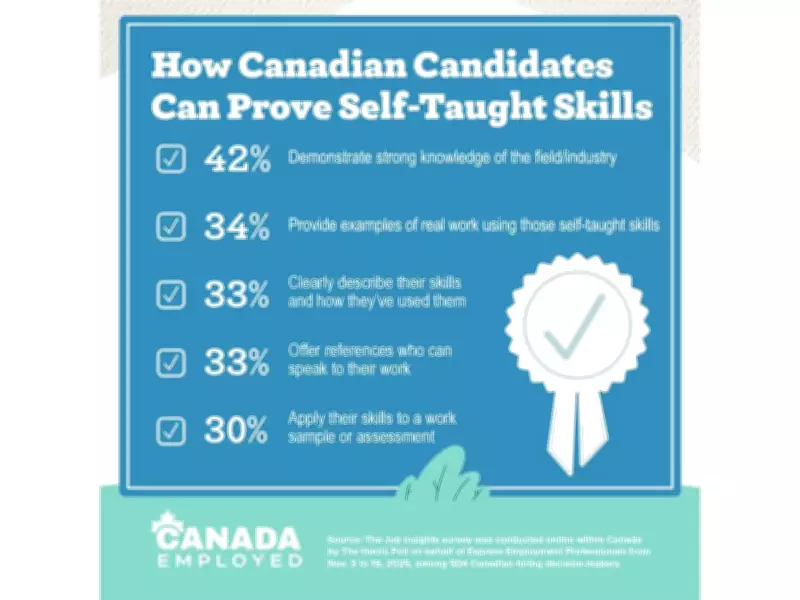
Hiring managers emphasize that resumes alone often fail to provide meaningful clarity about a candidate's capabilities. A striking 86% say demonstrating how skills were used, or how they would be applied in practical situations, is more effective than reviewing a resume listing. Employers seek concrete evidence to validate self-taught claims, with specific factors boosting their confidence:
- References who can speak to the candidate's work (46%)
- Demonstrated industry knowledge (42%)
- Completion of work samples where self-taught skills were utilized (34%)
- Clear explanations of how self-taught skills were applied in previous roles (33%)
In today's hiring environment, binge-learning online is becoming more welcomed, but proof still outweighs platform. Employers want to see how candidates have translated digital learning into practical, measurable outcomes.
Evolving Hiring Practices
As self-taught skills become more mainstream, hiring processes are gradually evolving to accommodate this shift. According to the survey, 23% of hiring managers report their companies have already updated hiring processes to recognize and verify self-taught skills, while 41% say their organizations are planning such updates. However, 36% indicate there are no current plans to adjust hiring practices to reflect the growing prevalence of self-taught skills on resumes.
Larger employers are leading these changes, with 30% having updated their processes, compared to just 19% of medium- and small-sized businesses. This discrepancy suggests that larger organizations encounter self-taught candidates at higher volumes and face greater pressure to adapt their evaluation methods.
The Canadian job market stands at a crossroads, where the rapid expansion of digital learning opportunities clashes with traditional hiring paradigms. While self-taught skills offer unprecedented access to knowledge and career advancement, employers remain cautious, seeking reliable methods to verify competencies gained outside formal educational institutions.