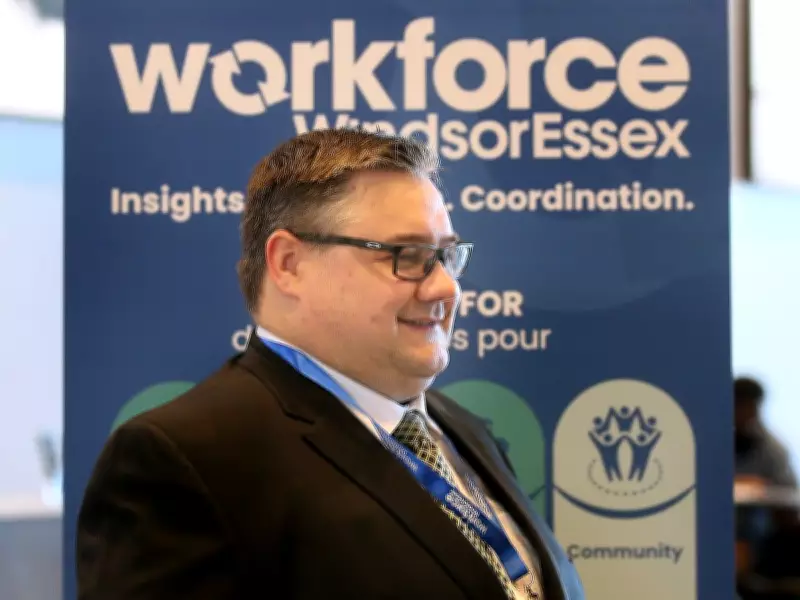
Windsor's Population Boom and Job Growth: Why Employment Challenges Persist
A new report from Workforce WindsorEssex reveals a paradoxical situation in Essex County: while the region has experienced explosive population growth and record employment levels, significant challenges remain in matching available jobs with qualified local talent.
Record Growth Meets Workforce Mismatch
Since 2020, Windsor-Essex has seen its population surge by approximately 50,000 people, growing from 438,328 to 488,738 residents. Of this population, about 407,600 are of working age, with approximately 245,800 employed as of December 2025. This represents sustained population and workforce growth that has pushed the region to record employment levels.
"We have people without jobs and jobs without people, and that's always a big concern," said Justin Falconer, CEO of Workforce WindsorEssex. "It's a frustrating recurring theme. This report really does look at workforce development and how we're helping people acquire those necessary skills to find employment."

The Skills Gap Challenge
The 210-page Windsor-Essex Community & Labour Market Plan for 2025-2026, unveiled at a special presentation at Landmark Cinemas, identifies a critical mismatch between available employment opportunities and the skills possessed by the local workforce. While companies are actively hiring and more people are seeking work, these interests don't always align.
Kelsey Santarossa, Director of Community & Workforce Development, noted that migration has been a "major factor" in the region's growth, with newcomers arriving from across Ontario, Canada, and internationally. "It's added a significant amount of folks to our working age population," she said. "That's where we're seeing the most significant growth."
Immigration Patterns and Integration Challenges
The report highlights changing immigration patterns that present both opportunities and challenges. While many immigrants have entered the workforce through programs like the federal government's International Mobility Program or post-graduate work permits, the region is also seeing higher proportions of resettled refugees and sponsored family immigrants.
"That poses additional challenges when we're thinking about what bridging programs, training programs, do we need to make available through our service provider networks," Santarossa explained. "We need to make sure that we can integrate these folks well into our community and into our local labour market."
A Community-Wide Solution
Falconer emphasized that addressing these workforce challenges requires a collaborative approach across multiple sectors. "It takes an entire community to do workforce development," he said. "It's not just on us. It's the school boards. It's the unions. It's post-secondary education. It's private training. Everyone needs to play a part in that."
The report was compiled by a team including Falconer, Santarossa, Tashlyn Teskey (Senior Manager of Research and Innovation), and executive liaison Lindsey Rivait. Their findings come at a critical time as young people enter the local workforce in record numbers, highlighting the urgent need for coordinated workforce development strategies.
Despite the region's economic growth and population expansion, the persistent gap between available jobs and qualified candidates underscores the complex nature of modern labor markets and the ongoing need for targeted skills development and integration programs.