Canada's vital automotive manufacturing sector finds itself in a precarious position, caught between the competing ambitions of the United States and China. The dual pressures threaten the future of an industry that has long been a cornerstone of the national economy.
Trump's Blunt Ambition: Bring Auto Jobs South
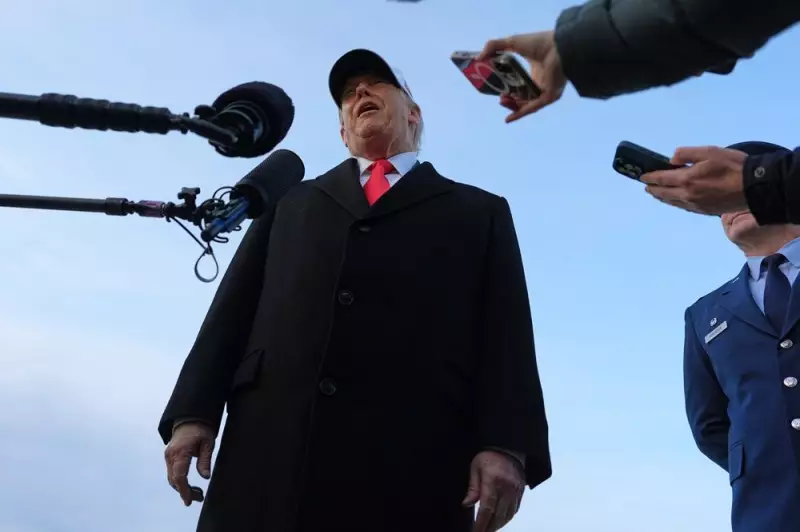
On Tuesday, January 13, 2026, U.S. President Donald Trump reiterated a stance that sends chills through Canadian auto plants. He explicitly stated a desire to move automobile production from Canada to the United States. Speaking to reporters at Joint Base Andrews in Maryland, Trump was unambiguous.
"I want to build the cars here, not in Canada. We used to build cars in Canada. Now the Canada cars … the Canadians are moving here to build cars," Trump declared. He also expressed indifference about renewing the Canada-United States-Mexico Agreement (CUSMA), the trade pact that currently governs North American auto production. This direct approach from the U.S. administration creates significant uncertainty for the integrated North American supply chain that Canadian manufacturers rely on.

China's Strategic Flood: Aiming for Market Domination
Simultaneously, a different but equally formidable challenge is emerging from across the Pacific. While President Trump is vocal about his intentions, China's strategy is one of market saturation. According to analysis, Xi Jinping's plan is not merely to compete but to achieve total automotive market domination.
This is not just a threat to Canada's emerging electric vehicle sector, but to the entire auto industry. The evidence of this strategy is visible globally. In Europe, Chinese vehicle market share for new sales exploded from less than 3% at the start of 2025 to over 10% by year's end. In some measurements, Chinese cars accounted for more than 10% of all sales in the latter part of that year.
The pattern repeats in Brazil, where Chinese vehicles grew from roughly 10% of vehicle imports in 2019 to 36% by October 2025. In Brazil's electric vehicle market, Chinese brands command a staggering 80% share.
A Hollowed-Out Industry: The Risk to Canadian Jobs
The scale of China's automotive ambition is staggering. Just 25 years ago, China produced about two million cars annually, fewer than Canada's nearly three million. Last year, China exported more than five million automobiles. Economist Robin J. Brooks, a senior fellow at the Brookings Institute in Washington, D.C., warns this is a deliberate, state-backed campaign.
"China is plowing massive resources into becoming a global player in cars," Brooks stated, noting the particular threat to European automakers. "This is where the competitive threat lies. China is flooding these markets with cars."
For Canada, which now produces approximately 1.3 million vehicles per year—a significant decline from its peak—the implications are severe. Opening the market to heavily subsidized Chinese vehicles could hollow out domestic manufacturing. The result would be a loss of high-paying jobs and increased economic reliance on a foreign power, without the reciprocal benefits of the integrated North American market.
Some may argue for cheaper consumer goods, but the long-term cost is profound. "If we hollow out our own manufacturing base, who will buy them? What jobs will there be?" the analysis questions. Beyond economics, security concerns regarding data privacy and embedded technology in Chinese vehicles add another layer of risk.
As former Bank of Canada governor Mark Carney engages with Chinese officials, the stakes for Canada's industrial future are clear. The country is at a crossroads, pressured from both its closest ally and a global strategic competitor. Navigating this challenge will require careful policy to protect a foundational industry from being crushed in the middle of a geopolitical struggle for automotive supremacy.