Brunswick Exploration Reports Major Lithium Discovery at Anatacau Project in Quebec
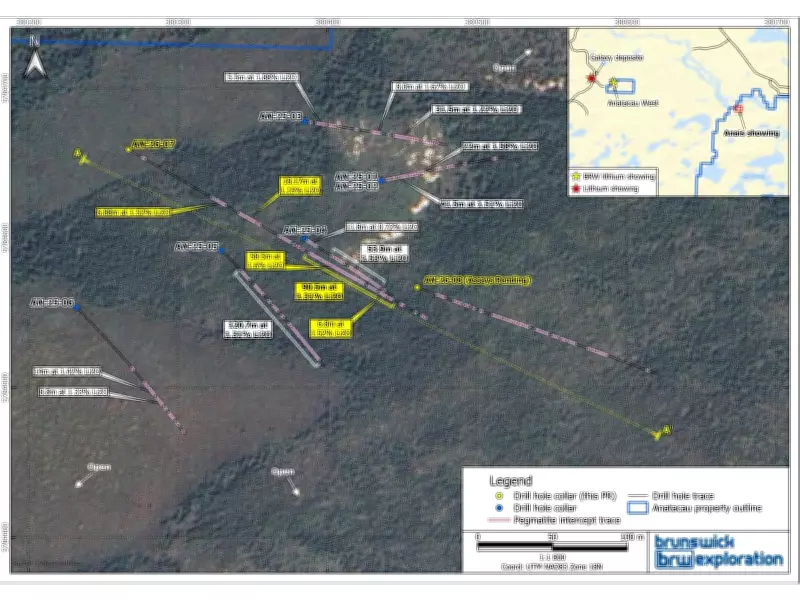
Brunswick Exploration Inc. has announced highly promising initial results from its 2026 winter drilling campaign at the Anatacau Main Project, located in the resource-rich Eeyou Istchee-James Bay region of Quebec. The exploration program was specifically designed to confirm and extend the down-dip and lateral extensions of the Anais Main dyke at depth while expanding the pegmatite trend eastward.
Exceptional Drill Results Reveal Substantial Lithium Mineralization
The drilling campaign has yielded remarkable findings, with drill hole AN-26-07 intersecting 90.5 meters grading 1.31% lithium oxide (Li2O) within a broader package of continuous lithium mineralization. This larger mineralized zone spans 167.9 meters at 1.02% Li2O, encompassing both country rock and pegmatites. Additionally, a newly discovered dyke below the Anais Main has been identified, measuring 6.8 meters with an impressive grade of 1.52% Li2O.
The Anais Main dyke has now been defined to a vertical depth of 190 meters, with all reported dykes remaining open in all directions for potential further expansion. The true thickness of the Anais dyke is estimated to be approximately 60% of the drilled intervals.

Company Leadership Expresses Enthusiasm for Project Potential
Mr. Killian Charles, President and CEO of Brunswick Exploration, commented on the significance of these findings: "These exciting first results underscore the potential of Anatacau, a rapidly growing project in our global portfolio. We are beginning to define a sizeable lithium system at Anatacau Main, which importantly remains open in all directions. The campaign is currently underway, with the aim of discovering additional large lithium pegmatites to the east."
Charles further emphasized the company's strategic position: "Alongside Mirage, Brunswick has two major exploration assets in the James Bay region of Quebec, placing it in an enviable position relative to peers. I look forward to sharing more results from this exciting campaign over the coming weeks."
Geological Context and Structural Significance
The continuity of the Anais dyke at depth has been confirmed through this drilling program, with the main dyke extending over 250 meters in strike length. Geological interpretation suggests the dyke is gently folded, oriented North-South to Northeast-Southwest, and dips at 85° to the west. It is hosted within highly folded and sheared meta-volcanic rocks.
Significantly, the mineralized dykes discovered at Anatacau to date straddle the southern side of an interpreted major deformation zone striking northwest-southeast. This structural control bears resemblance to the Galaxy deposit, suggesting similar geological conditions. The mineralized pegmatite dykes appear oriented parallel to the Anais dyke and intrude mostly meta-volcanic rocks, with one instance in metasedimentary rocks.
This geological finding is particularly important as it confirms that mineralization is constrained to the same structural corridor found at Rio Tinto's Galaxy project and Brunswick's own Anatacau West project, which is immediately contiguous to Rio Tinto's claim package located approximately 20 kilometers west of Anais.
Strategic Implications for Quebec's Lithium Sector
The Anatacau Main Project represents a significant development in Quebec's emerging lithium sector, with these results suggesting the potential for a substantial lithium system. The project's location in the James Bay region, known for its mineral wealth, positions Brunswick Exploration advantageously in the competitive lithium exploration landscape.
As global demand for lithium continues to rise, driven by the transition to electric vehicles and renewable energy storage, discoveries like those at Anatacau become increasingly valuable. The open nature of the mineralization in all directions suggests considerable potential for resource expansion as drilling continues.
Brunswick Exploration's ongoing campaign aims to discover additional large lithium pegmatites to the east, potentially further enhancing the project's value and contributing to Quebec's position as a significant lithium-producing region.