Imperial Metals Announces Significant High-Grade Drill Results at Mount Polley Mine
VANCOUVER, British Columbia – Imperial Metals Corporation has reported highly promising results from its ongoing diamond drilling program at the Mount Polley mine in British Columbia. The company's 2025 Phase 2 exploration initiative has yielded substantial mineralized intercepts, including a particularly noteworthy section measuring 11.0 metres with impressive grades of 4.43% copper, 1.53 grams per tonne gold, and 41.7 grams per tonne silver.
Comprehensive Exploration Program Details
The Mount Polley 2025 Phase 2 Diamond Drill Program consisted of nine strategically planned holes totaling 3,718.3 metres of drilling. This ambitious exploration campaign was designed with three primary objectives:
- Testing a high-grade mineralized zone located beneath the previously mined Wight Pit
- Expanding and defining the boundaries of higher gold-grade mineralization encountered at depth within the C2 zone
- Investigating potential depth extensions beneath the historic Bell Pit using innovative targeting techniques previously successful in the Springer Pit area
The company has received results from the first drill hole of this program, with additional assay data from the remaining holes currently pending analysis and review.

Detailed Drill Hole Analysis and Mineralization
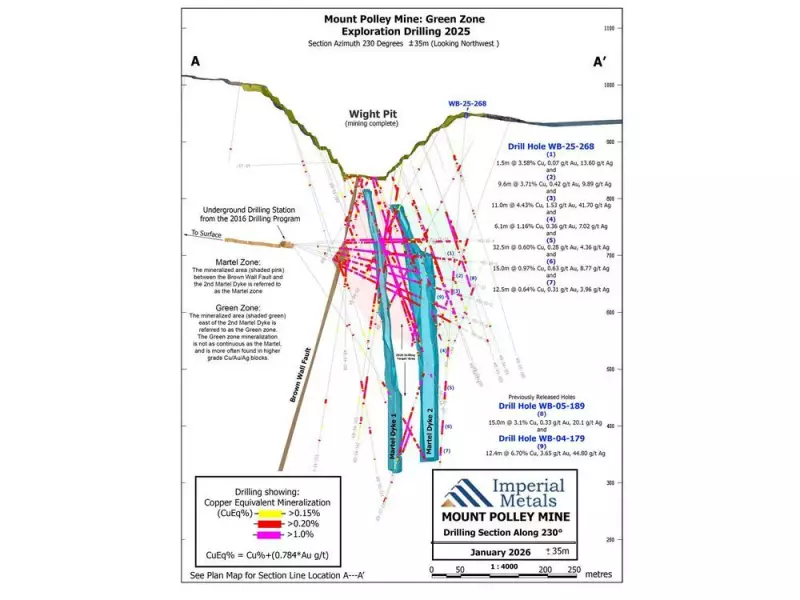
Drill hole WB-25-268 was strategically positioned on the eastern perimeter of the former Wight Pit, targeting a high-grade area within the Green zone adjacent to the established Martel zone at depth. This drilling initiative aimed to verify continuity and further delineate a mineralized zone originally identified by historical drill holes WB-05-189 and WB-04-179, which had previously returned significant copper, gold, and silver values.
The targeted intercept occurred at a depth of 304.4 metres, where the drill intersected an 11.0-metre section of hydrothermal fragmental potassic-altered breccia containing substantial bornite and chalcopyrite mineralization. Beyond this primary target zone, the drill hole revealed multiple additional mineralized intervals both above and below the main discovery area.
Comprehensive Assay Results and Geological Context
The complete assay results from drill hole WB-25-268 demonstrate multiple mineralized zones throughout the borehole:
- 1.5 metres grading 3.58% copper, 0.07 g/t gold, and 13.6 g/t silver from 254.6 metres
- 9.6 metres grading 3.71% copper, 0.42 g/t gold, and 9.89 g/t silver from 272.5 metres
- 11.0 metres grading 4.43% copper, 1.53 g/t gold, and 41.7 g/t silver from 304.4 metres
- 6.1 metres grading 1.16% copper, 0.36 g/t gold, and 7.0 g/t silver from 414.6 metres
- 32.5 metres grading 0.60% copper, 0.28 g/t gold, and 4.4 g/t silver from 467.5 metres
- 15.0 metres grading 0.97% copper, 0.63 g/t gold, and 8.8 g/t silver from 542.5 metres
The elevated silver-to-copper ratio observed in these results is characteristic of mineralization patterns typically found in the northeastern quadrant of the Mount Polley property. Imperial Metals has indicated plans for additional diamond drilling targeting this promising area during 2026.
Established Resource Base and Technical Oversight
The Martel zone, adjacent to the recent drilling activity, represents a previously defined underground resource containing substantial mineral inventory. According to Imperial's 2024 Annual Information Filing, the Martel Underground Indicated Resource as of January 1, 2025, comprises 2,272,000 tonnes of ore grading 1.14% copper, 0.30 g/t gold, and 7.20 g/t silver, containing approximately 57.3 million pounds of copper, 22,000 ounces of gold, and 526,000 ounces of silver.
Jim Miller-Tait, P.Geo., Imperial's Vice President of Exploration, has reviewed and approved this news release as the designated Qualified Person under National Instrument 43-101 standards for the Mount Polley exploration program. All samples were analyzed at Activation Laboratories Ltd. in Kamloops, British Columbia, with a comprehensive quality assurance and quality control program incorporating blanks, standards, and duplicates throughout the analytical process.

It is important to note that the reported assay intervals represent apparent widths, as insufficient geological information currently exists to confirm the geological model and determine true widths of the mineralized zones.