Predicting the future is a notoriously tricky business, yet as a new year begins, many Calgarians find themselves fixated on one crucial question: what lies ahead for the city's housing market? For most, their home represents either their largest investment or their most significant monthly expense, making the market's trajectory a matter of deep personal concern.
Three Potential Paths for Calgary's 2026 Housing Market
As we look toward 2026, industry observers outline three distinct scenarios that could unfold for Calgary's residential construction sector. The first possibility is a continuation of the recent boom, potentially setting a new record for housing starts. The second, and perhaps more sustainable path, would be a retreat to a healthier annual pace of between 17,000 and 20,000 new housing starts. The third, more pessimistic outlook, foresees starts dropping below 17,000, driven by potential over-building in recent years, an economic downturn, or a reduction in immigration levels.
Key Factors Influencing the 2026 Forecast
Several critical variables will determine which path the market ultimately follows. A primary driver is population growth; will Calgary continue to attract new residents from other provinces and countries at an above-average rate? The pace of new home construction by builders is another pivotal factor, alongside the question of whether developers have already overbuilt for the projected 2026 demand.

Local policy decisions will also play a major role. The potential repeal or modification of the City of Calgary's blanket rezoning bylaw could significantly alter development patterns, especially in the inner-city where land values have risen. Furthermore, the impact of federal housing incentive programs remains a variable, particularly if the local zoning landscape shifts.
The market's composition is another crucial element. The multi-family segment is increasingly dominated by purpose-built rental projects. In 2025, a striking 70% of new multi-family starts were rentals, with only 30% being condominiums. This trend's continuation will shape affordability and options for Calgarians.
Broader economic conditions cannot be ignored. Questions linger about how American tariffs might affect Calgary's economy in 2026 and whether interest rates will remain at levels conducive to buying and building.
Expert Insights and Conflicting Projections
Ann-Marie Lurie, chief economist at the Calgary Real Estate Board, anticipates a softening market in 2026. She cites declining immigration and uncertainty around future employment growth in the city as contributing factors. Lurie points out that three consecutive years of record housing starts have created a large supply of new homes, rentals, and condos, giving buyers and renters ample choice. This shift is already evident in some areas, with home prices in the northeast experiencing a 13% decline, a potential indicator of a broader market cooldown.
However, demand remains robust in certain segments. Prices for detached and semi-detached homes are holding strong across the city, particularly in sought-after inner-city neighbourhoods where redevelopment opportunities have increased land values.
The official projections from Canada Mortgage and Housing Corp. (CMHC) underscore the market's uncertainty. For 2026, CMHC forecasts total housing starts in a wide range, from a low of 17,500 to a high of 27,500. Within that, single-detached starts are estimated between 5,000 and 8,500, while multi-family starts (including duplexes, townhomes, and apartments) could range from 12,500 to 19,000. Even CMHC's low-end estimate would represent a healthy level of construction activity for the city.
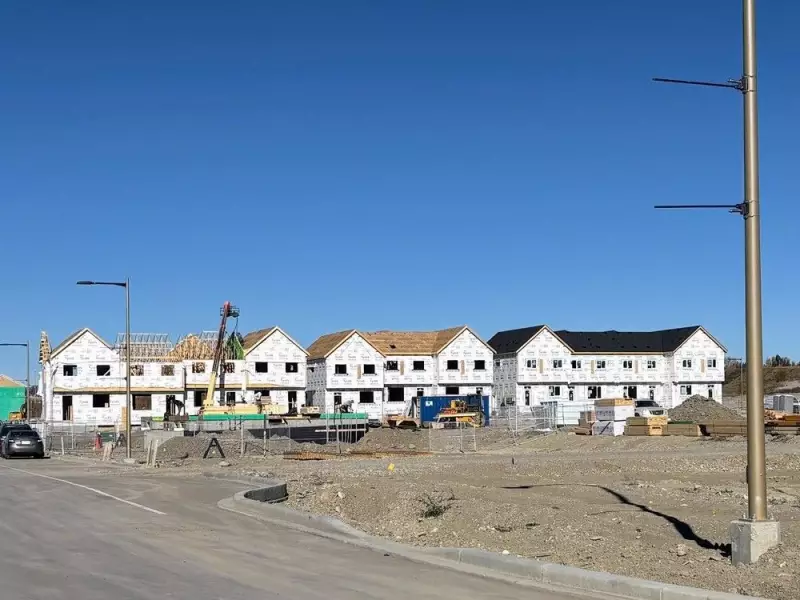
As 2026 approaches, significant development is expected to continue in burgeoning new communities like Taza. The final outcome for Calgary's housing market will hinge on the complex interplay of migration, economics, policy, and builder confidence in the months to come.