Montreal Real Estate Market Shows Continued Downturn in Early 2026
The Quebec Professional Association of Real Estate Brokers (QPAREB) has released its latest residential market statistics for January 2026, revealing a persistent downturn in the Montreal Census Metropolitan Area (CMA) that began in late 2025. The data, drawn from the Centris provincial database maintained by real estate brokers, paints a picture of a market experiencing significant shifts across different property types and geographic regions.
Significant Sales Decline Across Most Property Types
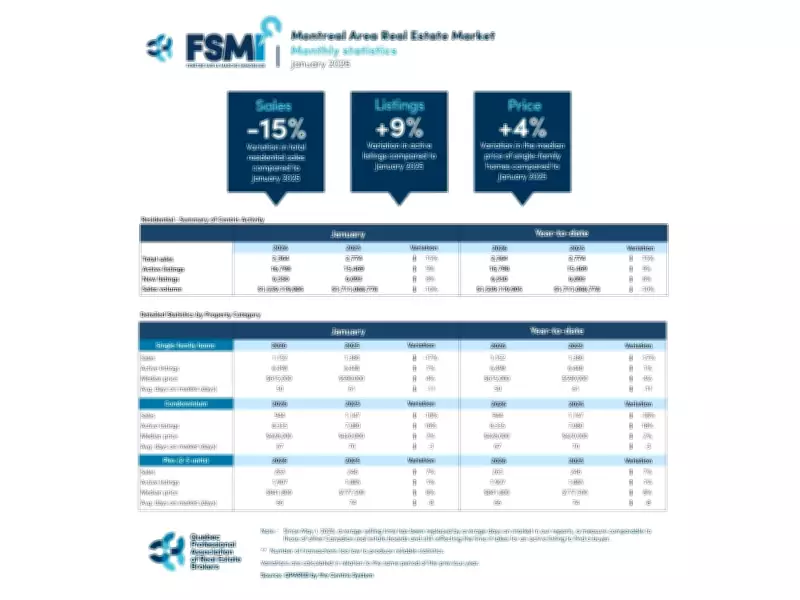
In January 2026, residential transactions in the Montreal CMA totaled 2,364, representing a substantial 15 percent decline compared to January 2025. This downward trend affected most property categories, though with notable variations in performance.
Single-family homes experienced the most significant impact, with only 1,152 sales recorded—a 17 percent decrease from the previous year. Condominiums followed closely with 944 sales, marking an 18 percent decline. In contrast, plexes emerged as the exception to the trend, posting 263 sales and achieving a 7 percent increase compared to January 2025.

Geographic Variations and Supply Dynamics
The market performance varied considerably across different regions within the Montreal CMA. Vaudreuil-Soulanges stood out with a modest 3 percent increase in sales, while other major sectors experienced declines ranging from 13 percent on the South Shore to a substantial 28 percent in Laval.
On the supply side, the number of listed single-family homes and plexes remained relatively stable, showing only a 1 percent increase. However, condominium listings surged by 18 percent, pushing supply slightly above the historical 10-year average for this property type.
Price Increases and Market Conditions
Despite the overall sales slowdown, prices continued to rise across all three property categories. The median price of single-family homes reached $615,000, representing a 4 percent increase. Condominiums saw their median price rise to $428,000, a 2 percent gain. Plexes experienced the most substantial price growth at 8 percent, reaching a median price of $841,800.
Market conditions have shown signs of stabilization in recent months. While sales have slowed, the time required to sell single-family home inventory remains below the historical average, maintaining a clear advantage for sellers. The condominium market on the Island of Montreal is showing signs of rebalancing, though sellers continue to enjoy favorable conditions in other major sectors.
The average number of days on the market decreased across all property categories: single-family homes dropped to 50 days, plexes to 66 days, and condominiums to 67 days.
Expert Analysis and Market Outlook
"January's data confirms the gradual weakening of sales observed in late 2025 in the Montreal area," explains Charles Brant, QPAREB Market Analysis Director. "This slowdown is due to a combination of factors, namely a continuing shortage of properties for sale, particularly single-family homes, and a high level of unaffordability limiting the purchasing power of some households."
Brant further notes that despite the moderation in activity, property scarcity continues to support prices, particularly for plexes, and maintains generally favorable conditions for sellers. However, he observes that the condominium segment is showing clearer signs of rebalancing.
"The stabilization of interest rates, recently confirmed by the Bank of Canada, makes the market more predictable for buyers and may gradually revive previously postponed purchasing plans," adds Camille Laberge, QPAREB Assistant Director and Senior Economist. "This development, however, does not eliminate the ongoing issues related to supply and affordability that continue to challenge the Montreal real estate market."
The QPAREB report provides detailed and cumulative monthly statistics for both the province and specific regions, offering comprehensive insights into the evolving dynamics of Quebec's residential real estate landscape.