The housing crisis in Ontario has reached a critical juncture, with new home sales collapsing to historic lows across the province. According to recent data, just 5,300 new homes were sold in the Greater Toronto Area throughout 2025, representing the worst annual performance in 45 years of record-keeping. This alarming trend extends beyond major urban centers, affecting markets from Calgary and Edmonton to Kitchener-Waterloo, where sales have plummeted dramatically.
A Decades-Long Crisis Intensifies
Ontario's housing shortage did not emerge overnight but has been decades in the making, fueled by restrictive policies, slow approval processes, excessive red tape, and exorbitant taxes. The current situation reveals that half-measures and incremental changes are insufficient to address the deepening crisis. The industry has clearly hit a wall, with condo apartment starts down 51 percent across most municipalities in the Greater Golden Horseshoe region.
Staggering Sales Declines Across Ontario
The decline in new home sales is both severe and widespread. In the City of Toronto, sales of new ground-oriented homes and condo apartments plunged from approximately 40,000 units in 2021 to about 2,000 in 2025. Similarly, in Kitchener, Waterloo, and Cambridge, sales fell from 2,000 to just 250 over the same period. December sales alone were down 82 percent from the 10-year average, highlighting the acute nature of the downturn.

Economic forecasts paint a grim picture for the future. The Canadian Centre for Economic Analysis predicts a deep and persistent slowdown in new housing construction, with starts expected to be 36 percent below the 10-year average and completions 39 percent lower. This slowdown could displace an average of 35,000 residential construction workers in Ontario, exacerbating economic challenges.
Construction Costs Outpace Market Realities
A key driver of the crisis is the persistently high cost of building new units, which makes them uncompetitive with the resale market. While home prices have fallen roughly 20 percent from their peak, construction costs remain stubbornly elevated. This disparity forces builders to shelve projects, further constraining supply and worsening the housing shortage.
Economist Mike Moffatt of the Missing Middle Initiative confirms that the housing weakness in the Greater Golden Horseshoe extends well beyond the condo market. His report for the Residential Construction Council of Ontario (RESCON) indicates that conditions are likely to deteriorate before they improve, as demand has sharply declined without a corresponding drop in construction expenses.
Government Response and Proposed Solutions
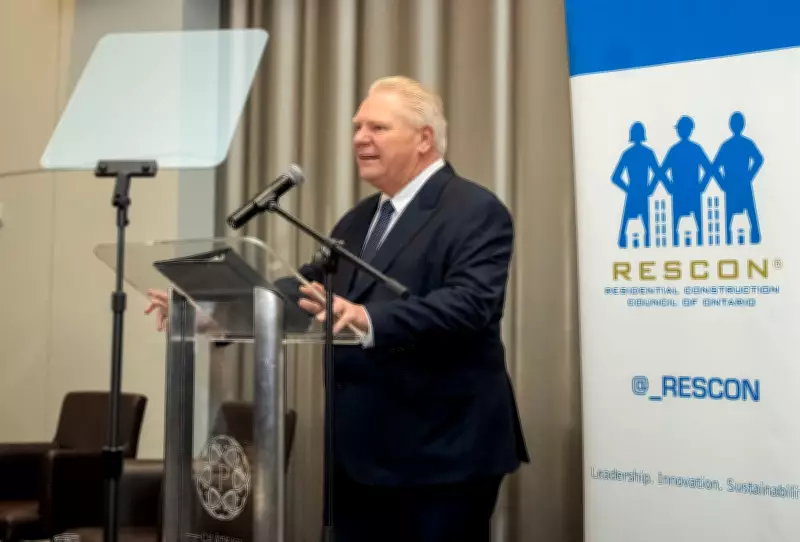
In a keynote speech at RESCON's recent annual general meeting, Premier Doug Ford addressed the housing crisis directly, emphasizing that housing is critical to Ontario's economic prosperity. He expressed readiness to collaborate with builders to accelerate construction and get shovels in the ground faster. Ford's remarks were encouraging and signaled a clear understanding of the necessary actions among provincial and municipal leaders.
The provincial government has already implemented several measures to alleviate the crisis, including streamlining approvals, reducing red tape, building housing-enabling infrastructure, and removing the provincial portion of the HST on new purpose-built rental housing. Additionally, a rebate on the eight-percent provincial HST for first-time buyers of new homes up to $1 million is scheduled to take effect once federal GST rebates are passed.
Another $1.6 billion has been allocated to the Municipal Housing Infrastructure Program, which has facilitated the construction of 800,000 homes across Ontario since 2014 by funding essential projects like roads, bridges, and water systems. However, Premier Ford acknowledged that more action is needed to address the root causes of the crisis.
Call for Comprehensive Action
To revitalize the housing market, experts recommend cutting sales taxes for all new home buyers, lowering development charges, and further accelerating approval processes. As Ford noted, if people are not purchasing homes, governments are not collecting revenue anyway. Reducing costs would stimulate construction activity, create jobs, and generate economic benefits across Ontario.

The commitment and understanding to tackle this housing Gordian Knot are evident among leaders. Now, decisive action must follow to pull out all the stops and correct course. The future of Ontario's housing market depends on bold, coordinated efforts to cut through regulatory barriers and make homebuilding economically viable again.
Richard Lyall is president of the Residential Construction Council of Ontario (RESCON). He has represented the building industry in Ontario since 1991.