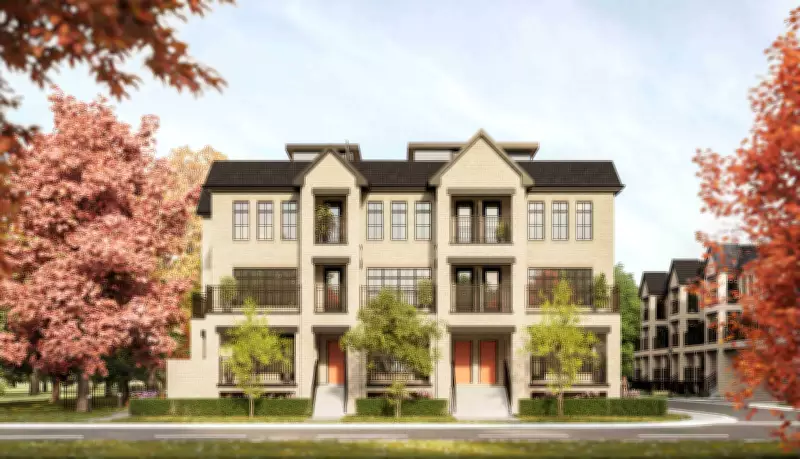
Toronto Real Estate Market Sees Historic Shift as Townhomes Outperform Condos
A significant transformation is underway in the Greater Toronto and Hamilton Area housing market, according to a comprehensive new report from Zonda Urban. For the first time since the early 2000s, townhome sales have surpassed condominium unit sales, marking a notable shift in buyer preferences and market dynamics.
Market Reaches Three-Decade Low
The multi-family market in the GTHA experienced its slowest year in three decades during 2025, with only 3,296 new units sold. This represents a dramatic 57 percent decline from the previous year's figures. The report indicates that sales of new condominium apartments plummeted by 65 percent annually, while townhouse sales decreased by 46 percent year-over-year.
Pauline Lierman, Zonda's vice president of market research, emphasized that "any semblance of a rebound in market activity failed to materialize throughout 2025." She noted that many developers are now grappling with delivering units that peaked during the latter half of the year, resulting in a significant surge in built unsold inventory.

The Townhome Advantage
Despite the overall market slowdown, townhomes emerged as a relative bright spot. In 2025, 1,763 townhomes were sold compared to 1,533 condominium units. Lierman attributes this shift primarily to changing price points, with the overall share of projects selling at an average price under $800,000 more than doubling from 15 percent in 2024 to 31 percent in 2025.
"Townhouse sales had their strongest quarter of the year in Q4-2025," the report notes, though these sales still fell 45 percent below the same period in 2024. The fourth quarter saw 838 total sales, including 314 new condominium apartment sales and 524 townhouse sales.
Condo Market Challenges Intensify
The condominium market faces particularly severe challenges. Cancellations of new condominium apartment units reached a peak of 4,007 units across 17 projects in 2025, with an additional 522 units cancelled during the first two weeks of January 2026. New condominium apartment starts in the GTHA dropped to just 3,621 units in 2025, a stark contrast to the peak of 30,610 units recorded in 2022.
Perhaps most telling is the dramatic reduction in new project launches. Only nine condominium apartment projects opened for sale during 2025, down from 21 launches in 2024 and a mere fraction of the record 101 launches that occurred in 2021.
Luxury Market Dominance and Future Outlook
The new condominium apartment market in 2025 was dominated by luxury developments. Five of the nine openings launched above $1,800 per-square-foot, all located in midtown neighbourhoods including Lawrence Park and Forest Hill. These projects, comprising just 278 units total, sold on average for $2,213 per-square-foot.
Looking ahead to 2026, Lierman expects little change in the outlook for condominium apartments compared to the second half of last year. "We expect the run of condo completions to decelerate considerably through the fall," she stated, adding that unsold built inventory may double from 2,079 units in Q4-2025 to nearly 4,000 units by mid-year.
Developers Shift Focus Beyond GTHA
An interesting trend noted in the report involves developers increasingly looking beyond the GTHA for opportunities. Lierman observes that there is currently a lot of "skipping over the GTHA" occurring, with developers focusing on communities outside the region such as Fergus and Woodstock.
Within the GTA, she points out that developers still maintain significant land holdings in certain hot spots, though the report does not specify these locations. This geographical shift suggests that developers are adapting their strategies in response to changing market conditions and buyer preferences.
The report paints a picture of a housing market in transition, with townhomes gaining ground against condominiums as buyers seek different value propositions in a challenging economic environment. As developers assess whether short-term price cuts outweigh the costs of holding unsold inventory, the market continues to evolve in unexpected directions.