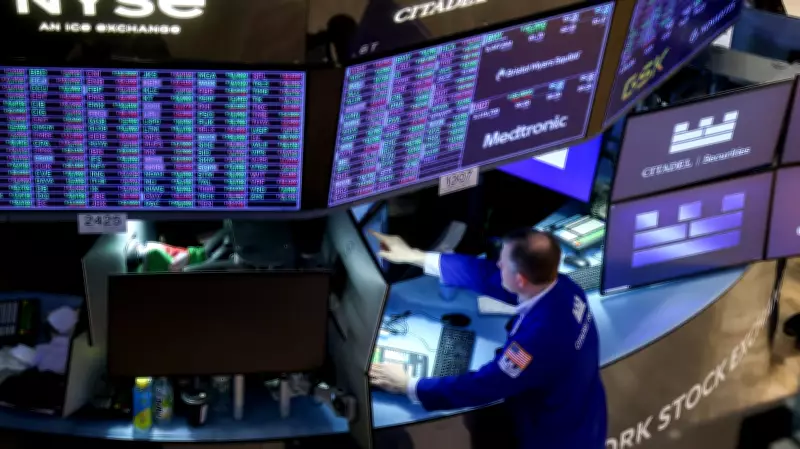
Renewed retaliatory strikes from Iran once again heightened anxiety in U.S. financial markets on Thursday, sending stock futures lower and propelling energy prices sharply upward, with prices at the pump surging overnight. The escalating conflict in the Middle East has injected significant uncertainty into global markets, with investors closely monitoring oil price movements as a key indicator of economic stability.
Market Reactions and Oil Price Surge
Futures for the Dow Jones Industrial Average declined by 0.3% ahead of the opening bell, while S&P 500 futures edged down 0.1%. Nasdaq futures also retreated by 0.1%, reflecting broad market unease. After a brief period of stabilization, crude oil prices resumed their upward trajectory early Thursday, underscoring the volatile nature of the current geopolitical landscape.
Stephen Innes of SPI Asset Management noted in a commentary, "Yesterday's bounce in risk assets already looks less like a turning point and more like a classic relief rally in a market that briefly inhaled before realizing the room was still on fire." This sentiment captures the fragile optimism among traders as tensions persist.

U.S. benchmark crude oil soared by $2.59 per barrel, or 3.5%, reaching $77.25—the highest level in over a year. Brent crude, the international standard, increased by 2.8% to $82.87 per barrel. This sharp rise in oil prices has already translated into a nearly 10% jump in gasoline costs. According to auto club AAA, the average price for a gallon of regular gas in the U.S. climbed from $2.98 one week ago, prior to the U.S. and Israeli attacks on Iran, to $3.25 today.
Inflation and Federal Reserve Implications
Investors are growing increasingly concerned about the duration of the conflict with Iran, the potential for higher inflation driven by expensive oil, and the subsequent impact on corporate profits. The broadening war complicates the Federal Reserve's efforts to control prices, as rising oil costs exert upward pressure on already elevated inflation levels. This scenario may reduce the likelihood of the central bank cutting benchmark interest rates, meaning borrowing costs for businesses and households could remain higher than anticipated just last month.
Global Market Movements
In early Thursday trading, Broadcom shares surged more than 6% after the chipmaker reported first-quarter profits that exceeded analyst expectations. The company highlighted that its AI revenue more than doubled from the same period a year ago, reaching $8.4 billion.
European markets showed mixed results at midday: Germany's DAX and the CAC 40 in Paris were effectively unchanged, while Britain's FTSE 100 inched up 0.1%.
In Asia, South Korea's Kospi rebounded sharply, jumping 9.6% to 5,583.90, recovering much of its historic losses from the previous day. The index had gained as much as 12% earlier as investors sought bargains, triggering temporary trading halts. The government announced emergency economic measures after the benchmark experienced its largest single-day decline on Wednesday. President Lee Jae Myung urged officials to activate a 100 trillion won ($68.5 billion) emergency financial package aimed at stabilizing market volatility.
Tokyo's Nikkei 225 index closed 1.9% higher at 55,278.06, while Hong Kong's Hang Seng climbed 0.3% to 25,321.34. This followed Chinese Premier Li Qiang's opening of the annual National People's Congress session, where he set an economic growth target of 4.5% to 5% for the year and proposed a 7% increase in military spending, down from 7.2% in recent years. The government pledged to support the sluggish domestic economy and boost consumer spending but did not unveil any major new stimulus measures.
Other Asian markets also saw gains: the Shanghai Composite index rose 0.6% to 4,108.57, Australia's S&P/ASX 200 increased 0.4% to 8,940.30, New Zealand's benchmark advanced 0.6%, and Taiwan's main share index gained 2.6%.

Currency Trading and Safe-Haven Demand
In currency markets, the U.S. dollar strengthened to 157.40 Japanese yen from 157.07 yen, while the euro fell to $1.1617 from $1.1636. Analysts attributed the dollar's advance to perceptions that the U.S. faces less direct risk from the Middle East conflict compared to other nations. Stephen Innes remarked, "When the world becomes less certain, capital gravitates toward the deepest pool of liquidity available," adding that the dollar "remains the market's preferred storm shelter."
The ongoing geopolitical tensions continue to shape market dynamics, with investors bracing for further volatility as the situation evolves.