Stock Market's Record High Conceals Significant Vulnerabilities
The remarkable surge in U.S. stocks during April, culminating in unprecedented benchmark levels, presents a facade of strength that masks several troubling indicators. Market analysts are raising alarms about what they term "unforeseen headwinds," including the disruptive potential of artificial intelligence technology and the ongoing geopolitical uncertainty surrounding the Iran conflict.
Narrow Leadership and Questionable Conviction
The equities benchmark achieved a stunning nearly nine percent increase throughout April, breaking through the 7,000-point barrier for the first time in history. Simultaneously, the technology-focused Nasdaq 100 recorded an impressive thirteen-session winning streak, marking its most extended period of gains since 2013. However, this apparent strength reveals underlying fragility when examined closely.
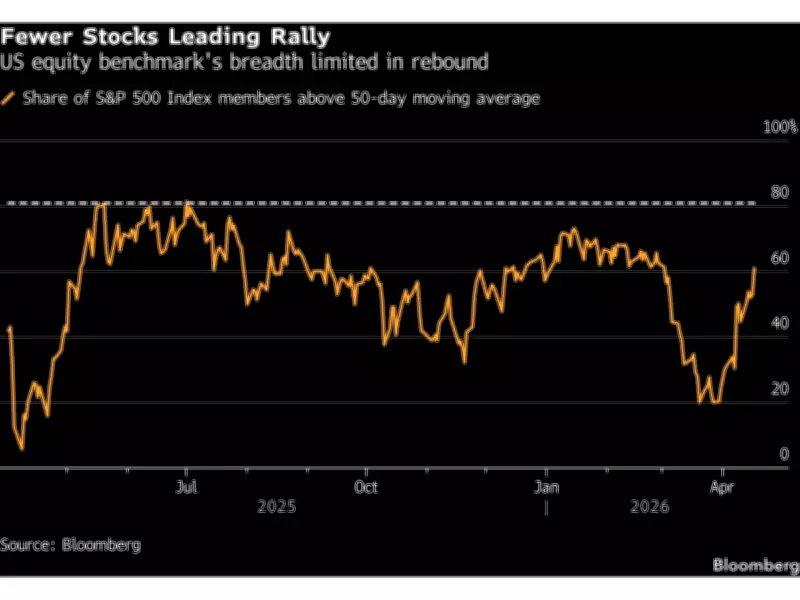
One prominent concern is the exceptionally narrow foundation supporting this advance. When the S&P 500 reached its historic peak last week, only approximately half of its constituent companies were trading above their fifty-day moving averages. This figure represents a substantial decline compared to previous market highs, including those achieved in January and following last year's tariff-related volatility.

Market strategist JC O'Hara of Roth Capital Partners LLC observed, "Investors are forced to like certain aspects of the current market, but they do not love the complete package. The manner in which this rally has developed suggests that the majority of potential gains have likely already been realized."
Volume Declines and Sentiment Divergence
Trading activity tells another story of diminished confidence. Data compiled by Bloomberg reveals that trading volume on the S&P 500 during April has fallen eleven percent below the six-month average. This contrasts sharply with March, when volume exceeded the average by nearly ten percent. According to O'Hara, this pattern indicates that investors demonstrated greater conviction during market declines than they currently exhibit during the recovery phase.
Sentiment measurements further underscore this disconnect. A Barclays PLC gauge of investor sentiment has actually declined despite the S&P 500's substantial surge. The bank notes this represents an "uncommon outcome given the speed of the rebound," with only five similar instances occurring over the past two decades during sharp market recoveries.
Stefano Pascale, head of U.S. equity derivatives at Barclays, explained, "The typical euphoria surrounding stocks has failed to materialize significantly, which contrasts with usual patterns when the S&P 500 rebounds from substantial selloffs."
Geopolitical and Technological Uncertainties
The market's recent performance has been influenced by geopolitical developments, particularly the ceasefire agreement between the United States and Iran approximately two weeks ago. While both major indices experienced substantial gains following this development, Wall Street strategists caution that these advances rest on unstable foundations.
Beyond international tensions, market participants anticipate weaker corporate guidance during the current earnings cycle. The combination of these factors provides investors with compelling reasons to maintain caution rather than fully committing to the rally.
Mark Hackett, chief market strategist at Nationwide, identified the primary drivers behind the rebound as speculators exiting positions betting against equities and institutional investors who had maintained underweight allocations being "pulled from the sidelines."
Performance Discrepancies and Future Outlook
Recent trading sessions have revealed performance disparities among different market measures. The S&P 500 index declined 0.2 percent on Monday, while an equal-weight version of the same index gained 0.3 percent but remains 0.4 percent below its most recent February peak. The Dow Jones Industrial Average, representing older economy sectors, has fallen 1.5 percent from its highest level.

As of Tuesday morning in New York, futures on the S&P 500 traded up 0.4 percent, indicating some continued optimism. However, O'Hara summarized the prevailing cautious sentiment, stating, "We lack an all-clear signal on the macroeconomic front. Investors remain somewhat skittish about fully reentering the market."
The intersection of artificial intelligence disruption potential, geopolitical uncertainties, narrow market leadership, and declining trading volumes creates a complex landscape where record highs may not tell the complete story of market health.