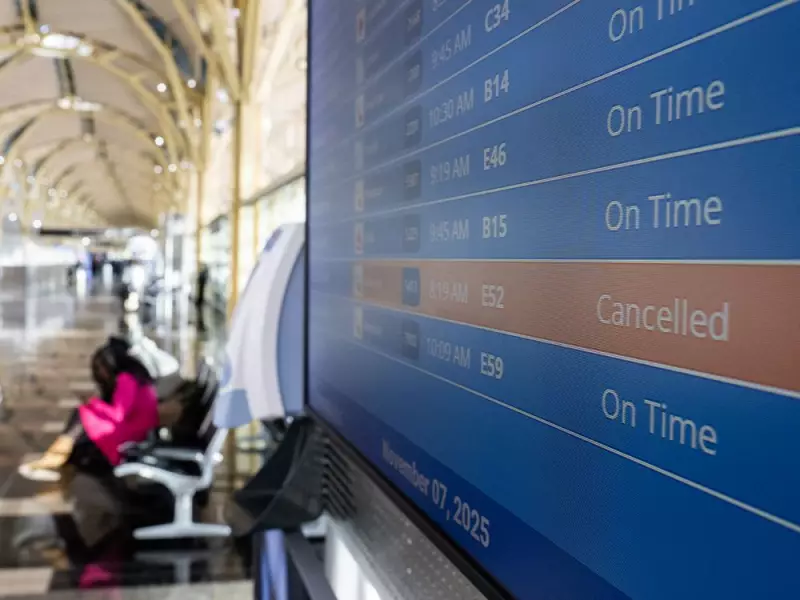
Longest U.S. Government Shutdown Sparks Air Travel Chaos
Airlines across the United States have begun cancelling hundreds of flights scheduled for the coming days, as the longest government shutdown in history severely disrupts air travel. This unprecedented situation is forcing thousands of passengers to change their plans and highlights a critical flashpoint in the ongoing political clash over federal funding.
The world's busiest aviation market is facing significant strain, with the four largest airlines suspending numerous services. The Republican-led administration insists these reductions are essential for maintaining safety amid staffing shortages caused by the shutdown. However, at least one top congressional Democrat has demanded more transparency, questioning whether the move is politically motivated.
Staffing Crisis and Flight Reductions
At the heart of the issue are more than 13,000 air traffic controllers who have been forced to work without pay, creating both an emotional and financial toll. The Federal Aviation Administration (FAA) has expressed deep concern, stating, "With continued delays and unpredictable staffing shortages, which are driving fatigue, risk is further increasing, and the FAA is concerned with the system’s ability to maintain the current volume of operations."

In response, the U.S. Transportation Department and FAA announced an order for airlines to cut 10 per cent of flight capacity across 40 major airports. This plan, unveiled by Transportation Secretary Sean Duffy and FAA Administrator Bryan Bedford, is an effort to relieve pressure on the struggling aviation system.
According to data from aviation analytics company Cirium, out of 25,375 flights scheduled for Friday, fewer than three per cent have been cancelled so far. The most affected carriers are United Airlines Holdings Inc., which is scrapping 510 flights through Sunday, and American Airlines Group Inc. The highest number of cancellations are occurring on intrastate routes in Colorado and Texas.
Impact on Travelers and Airline Strategy
Analyst Tom Fitzgerald from TD Cowen compared the current situation to a severe weather event. "Probably right now it’s more akin to a snowstorm or a stretch of bad weather than a catastrophic breakdown," he said in a Bloomberg Television interview. "The swing factor will depend on how long this lasts. I would say all the major airlines are going to feel this."
Airlines are leveraging their experience with navigating disruptions like storms. They are mitigating the fallout by strategically cutting capacity on their least occupied routes. United has clarified that the reductions focus on regional and domestic mainline flights that do not travel between its primary hubs. Importantly, the cuts do not apply to international flights.
On the ground at major airports, the disruptions were initially manageable. At New York’s LaGuardia Airport on Friday morning, business was largely running as usual with only a handful of cancellations. Data from Flightaware.com showed 23 cancelled flights at Newark Liberty International Airport, 40 at O’Hare International Airport in Chicago, and 27 at Los Angeles International Airport.
The FAA's order also includes a ban on commercial space launches and reentries during certain hours beginning Monday, further illustrating the wide-reaching impact of the staffing crisis. As the shutdown continues, the risk of more significant travel disruption extending into next week remains high, leaving both the industry and passengers in a state of uncertainty.