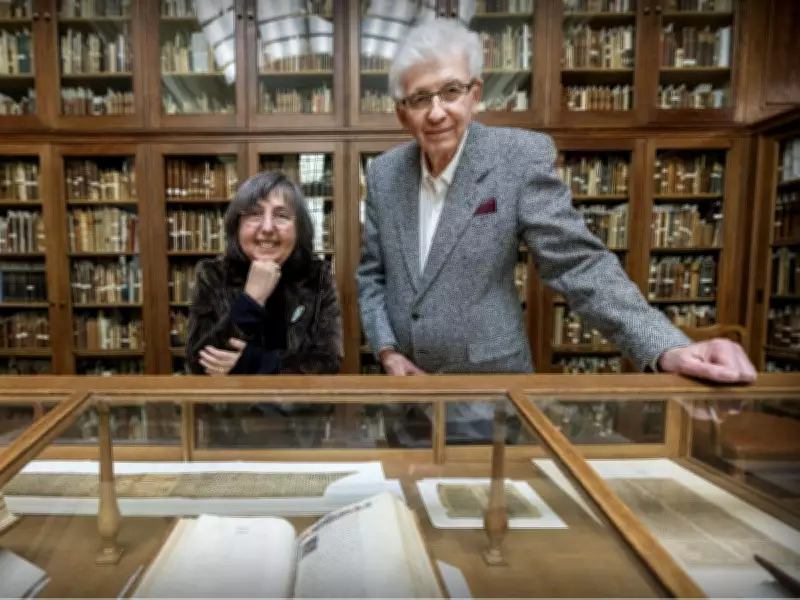
Brenda Dunn-Lardeau, an associate professor of medieval and Renaissance literature at Université du Québec à Montréal, stands before a glass case in the entryway of McGill University's Osler Library of the History of Medicine. Her gaze is fixed on three copies of Pliny's Historia naturalis, an ancient Roman encyclopedia on the natural world written in the first century AD. These versions, however, were published in Germany in the 15th century, shortly after Gutenberg's printing press revolutionized information dissemination, and were intricately hand-decorated by Italian artisans for wealthy buyers.
A Precious Collection on Display
This marks the first time these 1472, 1481, and 1497 editions of Pliny—along with several other early books known as incunabula—have been publicly exhibited. The exhibition, which runs until April 2, offers a unique opportunity to behold the building blocks of medical discovery and explore the rich holdings of an institution that, while world-renowned, remains less known to many Montrealers. "Here we have a very, very precious Pliny cluster," Dunn-Lardeau remarked during a recent tour of the exhibit she curated. "This book was highly influential. It's a must in a medical library."
Bridging Past and Present
Dr. Rolando Del Maestro, director of McGill's Neurosurgical Simulation and Artificial Intelligence Learning Centre and an honorary librarian at the Osler Library, highlights the continuity of knowledge. He holds up a modern reproduction of the Fasciculus Medicina, a 1493 Italian translation whose original is housed in the Osler's collection. One of its woodcuts depicts a physicians' library with Pliny's seminal work prominently propped open. "It's rather amazing," Del Maestro said. "They're right here—the open book, it's that book." This full-circle moment echoes the vision of Dr. William Osler, who bequeathed thousands of volumes, including many incunabula, to establish the library at McGill's medical school upon his death in 1919.

The Legacy of Dr. William Osler
Osler, often called the "father of modern medicine," graduated from McGill and went on to chair the University of Pennsylvania medical school, found the faculty of medicine at Johns Hopkins University, and serve as Regius professor of medicine at Oxford University. His contributions included instilling humanism in medicine by emphasizing the importance of doctors learning from patients. A dedicated bibliophile, Osler's collection continues to serve as an invaluable teaching tool in the 21st century. Del Maestro recently brought students from his AI lab to the exhibit, noting, "In Osler's mind, it was really the ability of medical students to engage not only in the present, but in the past, and sort of bridge that gap in a knowledge-filled way."
Understanding Incunabula
Incunabula, derived from the Latin word for "cradle," refer to books published between the 1450s and 1500, representing the infancy of the printing industry. This period was marked by experimentation in publishing, from page layouts to font development, some of which are still in use today. While most early mass-produced books were Bibles, about one-quarter of incunabula were medical tomes. The exhibition features items from both the Osler Library's archives and McGill's department of rare books and special collections, totaling close to 300 incunabula—one of the largest collections in Canada.
Art and Science Intertwined
Dunn-Lardeau focused the exhibit on illuminated or illustrated incunabula, as most were originally black and white. Wealthier buyers would take their plain copies to illuminators for decoration, including painted borders, illustrated initials, diagrams, and stamped coats of arms. This hand-finishing transformed the books into luxury items and sustained illuminators as mass printing grew. "That's another interesting aspect," Dunn-Lardeau explained. "They're not just painting Bibles or religious books; also medical, scientific books. It's a cultural attitude: respect for the books and beauty that can be everywhere."

Unraveling Mysteries
Part of Dunn-Lardeau's research involves identifying the artisans behind these works, as most did not sign them. She has linked one intricately finished Pliny volume to the Pico Master. However, a modern mystery remains: an unadorned 1478 copy of Celsus's De medicina liber, which Osler had decorated by a young woman studying illumination at Oxford around 1910. Dunn-Lardeau has been unable to uncover the artist's name, despite extensive searches. "That's my deepest wish, to know who," she said. "It's a bit surprising because William Osler took pains to annotate his purchases, but somehow he didn't put her name."
Broader Implications and Future Goals
Mary Hague-Yearl, head librarian at the Osler, emphasized the exhibition's role in showcasing and studying these gems. "For me, I think part of what's really fulfilling is seeing and enjoying the scholarship that's behind it," she said. "There is something deeply touching about interacting with those materials." Beyond incunabula, the Osler holds over 100,000 items, including ancient Japanese dissection scrolls, a first-edition Copernicus, and pre-publication copies of John McCrae's In Flanders Fields.
Challenges and Relevance Today
Dr. Mario Molina, a California-based physician and health CEO on the Osler Library's board, calls it "one of the finest medical-historical libraries in North America" but notes it faces underfunding, relying on philanthropy for many activities. Recently, $4 million was raised to fund the head librarian's role, allowing for the hiring of an assistant librarian. In an age of artificial intelligence and genomics, the history of medicine remains crucial. "We've forgotten that disease is only a part of this. Illness is the whole experience that person has," Molina said. "That's something that Osler and ancient Greeks emphasized—the patient matters. It's not just the disease."
Dr. David Wolf, a professor of medicine at Cornell University and president-elect of the American Osler Society, added that digitization efforts enhance access but can miss nuances. Exhibits like this promote Osler's values: "The best doctors are also interested in the humanities. You can learn a lot from the past." The Osler Library's exhibition not only preserves history but inspires a deeper appreciation for the art and science of medicine, connecting generations through the pages of these rare books.