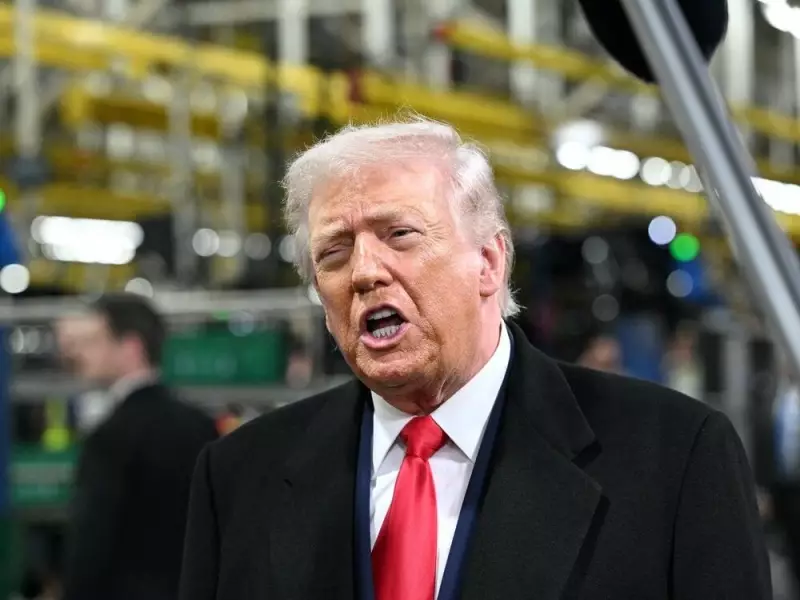
As former U.S. President Donald Trump revives discussions about acquiring Greenland, contemplates the future of Venezuela's vast oil reserves, and suggests his secretary of state could lead Cuba, academics from the University of Windsor argue this rhetoric reflects a deeper, historical pattern of American ambition rather than a novel political stance.
A Pattern Centuries in the Making
Gregg French, an assistant professor of history at the University of Windsor, points to Trump's military strike on Venezuela's capital, Caracas, on January 3, 2026, and the arrest of President Nicolás Maduro and his wife as a contemporary example of a well-established U.S. playbook. "This is a very clear example of history repeating itself," French stated.
He explains that Trump's subsequent pledge to "run" Venezuela fits into a lengthy chronology of U.S. interventions in the Western Hemisphere that originated in the 19th century. According to French, Washington has a documented history of overthrowing governments to install leaders who align more closely with American political and economic interests. "Though the names may change, the economic, political, social and cultural views of the U.S. remain consistent," he added.

The 'Donroe Doctrine' and Historical Precedent
Jamey Essex, a professor of political science at the same institution, observes that Trump's approach to foreign policy often appears to "build on something that already exists, as opposed to breaking norms." This perspective challenges the common view of Trump as a wholesale disrupter of international relations.
Essex highlights Trump's recent and frequent references to the Monroe Doctrine, the 1823 policy formulated by President James Monroe that asserted U.S. dominance over the Americas. Trump has even coined his own version, dubbing it the "Donroe Doctrine." However, Essex remains skeptical about the depth of this formulation, remarking, "I don't know that Donald Trump has fully formulated a foreign policy stance."
Nostalgia for an Imperial Past
Professor French suggests that a powerful sense of nostalgia, central to the "Make America Great Again" ethos, provides a coherent thread to Trump's international agenda. "It's intentionally vague, but it draws on the feeling of individuals and, in some ways, that feeling is reinforced by fact in the sense that the United States was, in fact, an empire, and it is continuing to act imperialistically," French explained.
He draws a direct parallel between historical and modern motivations, noting that while the late 1800s and early 1900s were driven by commodities like sugar, bananas, and coffee, today's imperial interest is "very much driven by oil." Trump's explicit pledge for the U.S. to take control of Venezuelan oil production, French argues, signals a potential test case for the scale of the president's global ambitions.
The Windsor scholars conclude that current events should be viewed not as an aberration but as an escalation within a long continuum of U.S. foreign policy, where economic interests and hemispheric dominance have been consistent guiding principles for generations.