Memorial University Job Postings Explicitly Exclude White Male Applicants
In a significant development within Canadian academic hiring practices, Memorial University in Newfoundland and Labrador currently maintains five active job postings that explicitly prohibit applications from heterosexual white men. These positions, all funded through federal research programs, represent a notable shift in employment equity implementation at the institution originally founded to honor predominantly white male war casualties.
Historical Context Meets Modern Equity Mandates
Memorial University was established as a living memorial to commemorate the substantial number of Newfoundland men who perished during the First World War. The university's founding documents emphasize that the institution exists so that their "cause and sacrifice might not be forgotten." This historical context creates a striking contrast with current hiring practices that exclude the demographic group that constituted the overwhelming majority of those wartime losses.
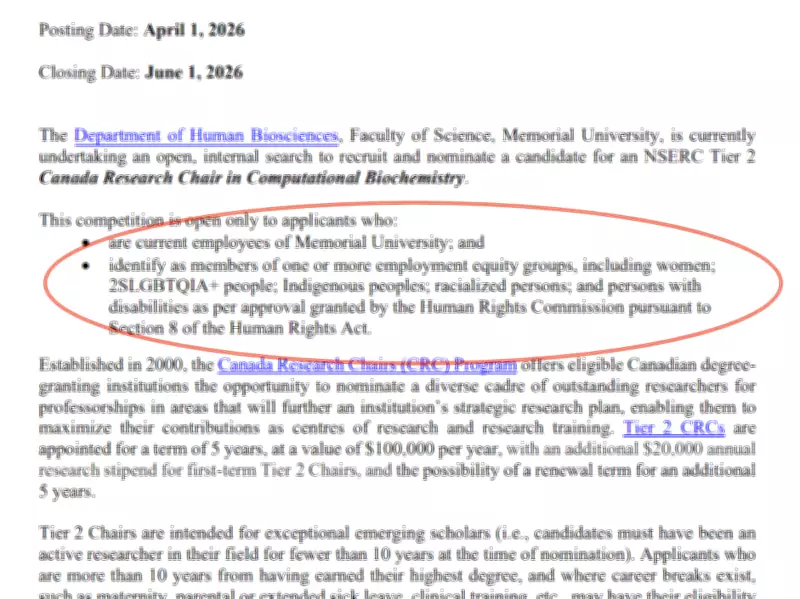
The five restricted positions include research roles in computational biochemistry, musculoskeletal health, AI-driven navigation for Arctic environments, Indigenous knowledge with digital technology, and community health with substance use. Each posting specifies that applications are exclusively open to "women; 2SLGBTQIA+ people; Indigenous peoples; racialized persons; and persons with disabilities."

Federal Funding Requirements Drive Hiring Restrictions
These hiring practices appear directly connected to federal funding mandates. All five positions receive financial support through the Canada Research Chairs Program, a $311 million federal initiative supporting approximately 2,000 academic positions nationwide. The Memorial University postings represent a combined $2.5 million in research funding for the institution.
Since 2021, Canada Research Chair funding has incorporated strict equity, diversity, and inclusion requirements. Program guidelines mandate that at minimum 22.9 percent of positions must be filled by racialized individuals, 4.9 percent by Indigenous people, 7.5 percent by people with disabilities, and 50.9 percent by women or transgender individuals.
Academic Hiring Trends and Controversial Responses
Independent journalist Chris Brunet first highlighted these restricted postings through social media, noting that each position explicitly prohibits white male applicants. The revelation prompted significant discussion about equity implementation in academic hiring.
Former Alberta premier Jason Kenney responded by observing that none of the Newfoundland men memorialized by the university's founding would now qualify to teach there under current hiring restrictions. He characterized the development as evidence that "DEI has gone too far for too long."
While equity considerations have become increasingly common in Canadian university hiring, explicit exclusions based on identity characteristics remain relatively uncommon. A 2025 Aristotle Foundation study examining 489 job postings across ten Canadian universities found only 16 positions that discriminated against candidates based on natural characteristics or group identity.
Broader Implications for Academic Employment
The Memorial University situation highlights the tension between historical institutional identities and contemporary equity objectives. As universities navigate federal funding requirements while addressing historical imbalances in academic representation, such explicit hiring restrictions raise questions about implementation methods and potential unintended consequences.
The positions in question are five-year research postings primarily within scientific disciplines, suggesting that equity initiatives are expanding beyond traditional humanities and social science domains into technical and scientific fields where representation gaps have been particularly pronounced.
This development at Memorial University represents a notable case study in how Canadian academic institutions are implementing equity mandates through hiring practices, particularly when those practices conflict with historical institutional identities and founding principles.