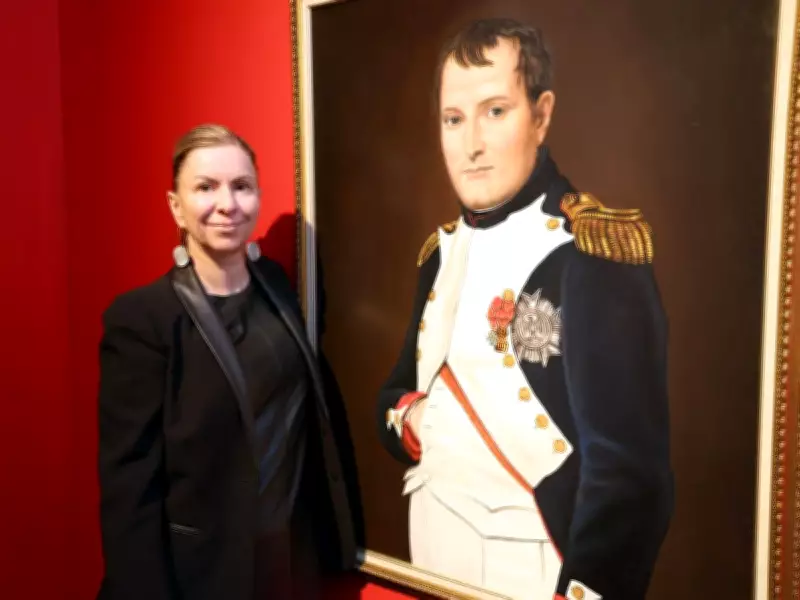
The first artifact visitors encounter at the Nickle Galleries' new exhibition, Napoleon: Art, Money and War, is a striking portrait of the military leader and first emperor of the French. Although painted in the 20th century by artist Loren Chabot, the oil on canvas captures Napoleon Bonaparte at the zenith of his power, meticulously managing his public image. Dressed in military attire, he assumes his characteristic hand-in-waistcoat pose, exuding regality, dignity, and authority.
If this portrait presents Napoleon as a larger-than-life mythic figure, the subsequent piece underscores his mortality. A plaster death mask of Napoleon, originally cast in 1821 by Dr. Francesco Antommarchi—the physician attending the general during his final days in exile on St. Helena—offers a stark contrast. The mask serves as a poignant reminder of his human fragility.
“It is about life and death, and everything in between,” says Marina Fischer, curator of numismatics for the Nickle Galleries, part of Libraries and Cultural Resources at the University of Calgary. “It really encapsulates the authority he amassed, how he wished to be seen, and how he presented himself.”

Exhibit Highlights and Collections
Some artifacts originate from the gallery’s permanent holdings, which include Canada’s largest academic numismatic collection—featuring 23,000 coins, paper money, tokens, and medals. This “money collection,” established after the Nickle family donated 10,000 ancient coins to the university in the 1960s, forms the core of the gallery’s identity and frequently features in exhibitions and workshops.
However, approximately two-thirds of the Napoleon: Art, Money and War exhibition comprises items on loan from an anonymous Edmonton-based collector who has spent 40 years amassing Napoleon-related artifacts. Among these is the rare death mask.
Antommarchi created the cast shortly after Napoleon’s death but withheld the masks from the market until 1833, when a limited number were distributed in plaster and copper. The displayed mask was promptly acquired by a noble Belgian family in 1833, passed down through generations, and eventually sold in Germany 155 years later.
“When the owner was working in Germany in his 20s, he saw an advertisement that the mask was for sale,” Fischer explains. “The sellers had no particular use for it and wanted to pass it on.”
This mask stands as one of the exhibition’s centerpieces. History enthusiasts will also appreciate a broken sword from a British Heavy Cavalry trooper, believed to be a relic from the Battle of Waterloo in 1815—the conflict that ended Napoleon’s reign and the Napoleonic Wars.
Napoleon’s Controlled Image
A significant portion of the exhibition delves into Napoleon’s carefully curated image. During his reign from 1804 to 1814, he oversaw military triumphs and sweeping reforms to legal and economic systems. While military might and strategy reshaped Europe, Napoleon also built, maintained, and projected power through visuals and symbols that portrayed him as a heroic and stabilizing force.
The exhibition runs at the Nickle Galleries until a future date, offering a comprehensive look at the complex legacy of one of history’s most influential figures.