There is such a thing as too much togetherness. So when architects Tillie Kwan and Bettina Balcaen designed a family retreat on Savary Island, they made room for everyone to gather — and spaces to slip away, too.
The property sits on the north side of Savary, a 7.5-kilometre-long crescent of forest and white sand beaches off the coast of Powell River. The owners had been coming to the island for a decade but had outgrown their longtime family cabin.
Designing for Multi-Generational Living
“Now that the kids are adults, they wanted those kids to come back, maybe with potential partners, maybe with grandkids, to continue that tradition of providing a vacation place, but one that’s bigger and can be more multi-generational,” says Balcaen.

Rather than one large dwelling, Kwan and Balcaen — partners in Vancouver’s Balcaen Kwan Architecture and Design — created a series of three separate cabins, connected by a wraparound deck.
The central cabin houses a primary suite and the main social spaces, including a dining room and kitchen, while a “family cabin” harbours four bedrooms, two bathrooms, a kitchenette with an eating nook and a living area. A third cabin adds a guest bedroom with its own bathroom, plus a wood-fired sauna and a flex space that can be used as a den, gym or remote office.
“[The layout] had to be flexible enough that it could accommodate a smaller or larger gathering. It also had to have enough separation that people could get away and do their own thing, and not be in each other’s space all the time,” says Balcaen.
Remote Location Informs Design
The remote location also informed design. Accessible only by boat, the property relies on solar power, a septic system and a propane-fired stove. Rainwater harvested from the rooflines irrigates a vegetable garden.
“We had to design [each] building so that it was architecturally interesting, but at the same time not too challenging to build,” says Kwan.
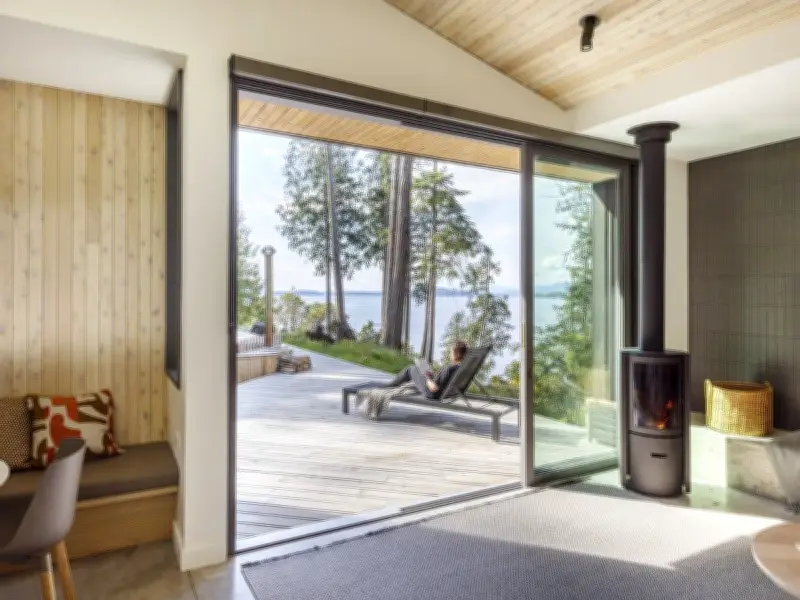
They started with a densely forested site, orienting the structures to capture ocean views to the north — looking out over the Strait of Georgia, Desolation Sound and Hernando Island. But this came with an indoor trade-off: limited natural light. So, Kwan and Balcaen added backward-facing dormers. “In addition to the big areas of glazing, we have these aperture-like clerestory windows that bring in light from above,” says Kwan.
Forest Integrated into Architecture
The forest found its way into the buildings, too. After a previous contractor cut down more trees on the site than the design team intended, they worked with Upward Construction — the eventual builder — to create an on-site mill, producing exterior siding from downed cedars. (They have since planted new trees to fill in lost canopy, along with native plant species such as salal, deer fern and kinnikinnick.)
Knowing the site-milled boards would have more natural irregularities than traditionally manufactured ones, they decided on a deep charcoal stain for the exteriors. But it felt right, too: “We really wanted the cabins to be almost like shadows in the forest, so that they look like they just slipped in and very lightly settled there,” says Kwan.
Interior Features and Furnishings
In the main cabin, a two-sided wood-burning fireplace by Stûv divides the living and dining areas without interrupting flow. Mid-century modern-inspired furniture and lighting contrasts the more rustic feel of the woods. Curved Sendai seating by Minotti and a custom dining table by Vancouver furnituremaker Lock & Mortise bring a soft counterpoint to the cabin’s clean-lined architecture, under blackened brass Aria pendants by Allied Maker.
Dormer windows bring in southern light, while a charcoal siding helps blend the natural texture of cedar siding harvested and milled onsite.
White oak millwork keeps the kitchen warm and quietly understated, while a long island topped with honed Infinity Black quartzite from Bourdignon creates space for meal prep and conversation. Risom counter stools by Knoll line one side, while clerestory windows draw natural light deep into the room.

A wraparound deck links the three cabins with spaces for cooking, dining and gathering. At one end, an outdoor kitchen with a barbecue and pizza oven extends living space outdoors, while a pulley-operated enclosure protects the area from weather.