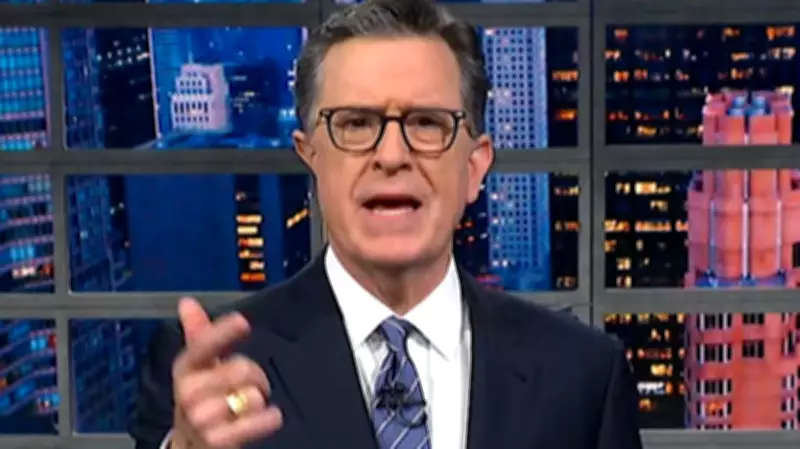
In a sharp critique on his Tuesday night broadcast, "Late Show" host Stephen Colbert targeted House Minority Leader Hakeem Jeffries, a Democrat from New York, for the guidance he provided to members of his party regarding President Donald Trump's State of the Union address. Colbert highlighted that Jeffries had advised Democratic lawmakers who attended the speech to avoid causing disruptions, a tactic Jeffries labeled as "silent defiance."
Colbert's Scathing Commentary on Democratic Strategy
Colbert humorously dismissed this approach, remarking that it was essentially a rebranding of inaction. He quipped, "Which I believe is a bold rebrand of doing jack squat. As Martin Luther King once said, 'Shhh.'" This sarcastic take underscored Colbert's view that the strategy lacked substantive impact, especially in the context of political protest.
Democratic Lawmakers' Varied Responses to the Speech
Many Democratic representatives chose to boycott the State of the Union entirely as a form of protest against Trump and his policies. However, not all who attended adhered to Jeffries' advice. Notably, Democratic Representatives Ilhan Omar of Minnesota and Rashida Tlaib of Michigan openly defied the call for silence by shouting criticisms at Trump during his address.

Omar was heard exclaiming, "You should be ashamed," while Tlaib added, "You have killed Americans." These outbursts highlighted a divide within the Democratic caucus on how to effectively oppose the president, with some opting for vocal dissent over quiet resistance.
Implications for Political Discourse and Party Unity
This incident raises questions about party cohesion and messaging strategies in high-stakes political moments. Colbert's monologue not only entertained but also sparked discussion on the effectiveness of different protest methods in today's polarized climate. The contrast between Jeffries' recommended "silent defiance" and the vocal protests by Omar and Tlaib illustrates the ongoing debate within the Democratic Party over how to challenge Trump's agenda.
As political tensions continue to simmer, such moments serve as a reminder of the complex dynamics at play in American governance, where every action—or inaction—can become fodder for public commentary and critique.