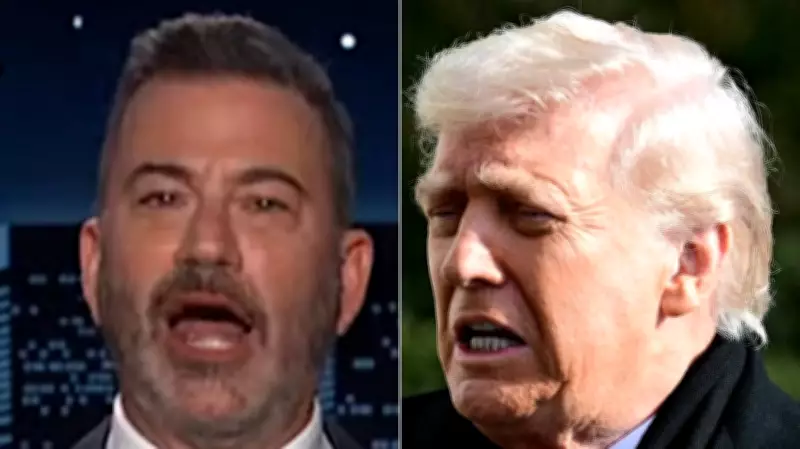
In his Monday night monologue, Jimmy Kimmel sharply criticized President Donald Trump's recent military strikes on Iran, pointing out what he called a bitter irony in Trump's actions. Kimmel highlighted that after ordering the bombing, Trump has been urging the Iranian people to rise up and topple their regime, a stance that contradicts his previous promises.
Contradictions in Trump's Statements
Kimmel noted that Trump typically only calls for the overthrow of governments when he loses an election, making this move seem hypocritical. To underscore this, Kimmel played clips from past years where Trump predicted that then-President Barack Obama would go to war with Iran to boost his poll numbers ahead of an election.
In a 2011 clip, Trump described such a war as a sign of a president who has absolutely no ability to negotiate and is weak and ineffective. Kimmel quipped, Well look at that, another prediction he got right. Nostra-Dumbass has done it again! suggesting that Trump's own words are now coming back to haunt him.

Kimmel's Theory on Motivation
Kimmel proposed another reason for Trump's decision to strike Iran, linking it to ongoing scandals. He asked rhetorically, When your best friend was a pedophile and you're losing bigly in the swing states with an election coming up, what do you do? Kimmel answered his own question by saying, I'll tell you what you do: You fire the weapons of mass distraction.
This comment references Trump's relationship with the late convicted sex offender Jeffrey Epstein, who was once a close friend. The assault on Iran coincides with new questions emerging about this connection, adding fuel to Kimmel's critique that the military action serves as a diversion tactic.
Broader Implications
Kimmel's monologue not only mocks Trump's inconsistencies but also raises concerns about the timing and motivations behind the Iran strikes. By juxtaposing Trump's past criticisms of Obama with his current actions, Kimmel paints a picture of a president whose strategies may be driven more by political survival than by diplomatic or military necessity.
The segment underscores how entertainment figures like Kimmel are increasingly using their platforms to comment on serious political issues, blending humor with pointed analysis to engage audiences in critical discussions about leadership and accountability.