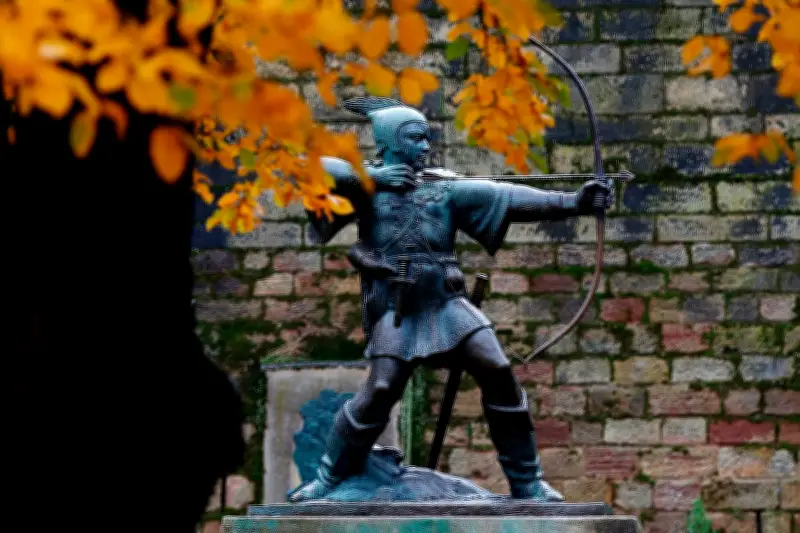
Nottingham today is a thoroughly modern town with only a few medieval remains and a statue 'remembering' Robin Hood. Yet the legend of the outlaw who stole from the rich and gave to the poor continues to draw visitors and historians alike to Sherwood Forest.
The Elusive Trail of the Real Robin Hood
For centuries, the story of Robin Hood has been shrouded in myth. Some historians believe he was a real outlaw active in the 13th or 14th century, while others argue he is purely fictional. The earliest ballads, dating from the 15th century, describe him as a yeoman living in the greenwood with his band of Merry Men.
According to local folklore, Robin Hood's base was in Sherwood Forest, a royal hunting ground north of Nottingham. Today, the forest covers about 1,000 acres, a fraction of its original size, but it still holds ancient oaks and hidden glades that evoke the outlaw's world.

Modern Nottingham and Its Medieval Remains
Nottingham Castle, a 17th-century mansion built on the site of a medieval castle, offers exhibits on Robin Hood. The city also boasts the oldest pub in England, Ye Olde Trip to Jerusalem, which dates from 1189 and claims ties to the Crusades. Yet the most famous landmark is the Robin Hood statue near the castle, erected in 1952 to celebrate the legend.
“Every year, thousands of tourists come to Nottingham hoping to find traces of Robin Hood,” said a local tour guide. “The legend is a huge part of our identity, even if the historical evidence is thin.”
Historical Evidence and Scholarly Debate
Historians have scoured medieval records for any mention of a Robin Hood. The earliest reference appears in the 1262 court rolls of Yorkshire, where a man named “Robin Hood” is listed as a fugitive. However, many scholars dismiss this as a coincidence or a nickname. A more promising lead comes from the 1320s, when a criminal named Robert Hood of Wakefield was outlawed for theft.
“The search for the real Robin Hood is like hunting a ghost,” said Dr. Emily Thompson, a medieval historian at the University of Nottingham. “We have fragments of evidence, but no smoking gun. The legend has been embellished so much over the centuries that the truth is almost impossible to untangle.”
Sherwood Forest Today
Sherwood Forest is now a national nature reserve, home to the Major Oak, a 1,000-year-old tree that legend says was Robin Hood's hideout. The forest attracts over 350,000 visitors annually, many of whom come for the Robin Hood-themed events and reenactments. In 2025, the forest hosted a medieval festival that drew 50,000 people.
Despite the commercialization, the forest retains a wild, mysterious quality. “Walking through Sherwood, you can almost imagine the outlaws lurking behind the next tree,” said a visitor from Canada. “It’s a magical place that brings history to life.”
The Enduring Legend
Whether Robin Hood was real or not, his story continues to resonate. The themes of justice, rebellion, and generosity have inspired countless books, films, and TV shows. In 2024, a new Netflix series about Robin Hood sparked a surge in tourism to Nottingham, with hotel bookings up 20%.
“The legend of Robin Hood is more than just a story,” said the tour guide. “It’s a symbol of hope for ordinary people. That’s why we keep searching for him, even if we never find the real man.”