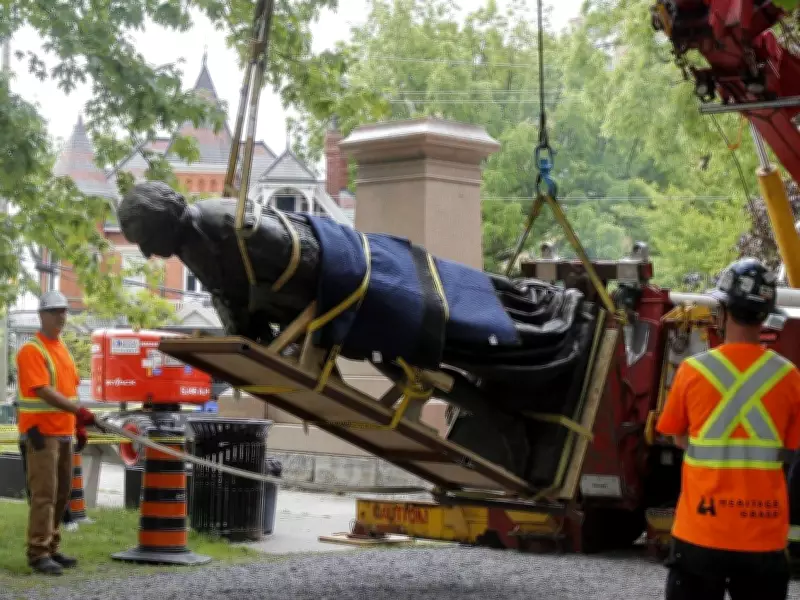
Kingston Residents Overwhelmingly Support Return of Macdonald Statue
A significant new poll conducted in Kingston, Ontario, has revealed that a substantial majority of local residents want the statue of Sir John A. Macdonald restored to its former prominent location in City Park. The survey, undertaken by Nanos Research and commissioned by the Canadian Institute for Historical Education, shows that 71% of those polled express support for returning the monument to its original pedestal.
Historical Context and Removal
Sir John A. Macdonald, Canada's first prime minister, had deep personal and professional ties to Kingston. He was born in Scotland but adopted Kingston as his Canadian home, where he first practised law and represented the riding in Parliament. The statue had stood in City Park for 126 years as a symbol of historical recognition before its removal in 2021.
The decision to remove the statue came after claims emerged about the discovery of hundreds of unmarked graves at a residential school in Kamloops. Kingston city council proceeded with the removal, citing contemporary sensitivities and historical reassessment. This action sparked immediate controversy and has since become a focal point for debates over cultural heritage and historical preservation.

Poll Results and Public Sentiment
According to the detailed poll findings, seven in ten Kingstonians specifically support or somewhat support restoring the statue to its original location. This breaks down to 59% who strongly support the restoration and an additional 12% who somewhat support it. These numbers indicate a clear public preference that contrasts with the council's earlier decision.
Many of Kingston's most distinguished academics, historians, and authors have publicly spoken out against the statue's removal. They argue that such actions represent a form of cultural vandalism that erases important historical narratives without proper public consultation or balanced historical analysis.
Broader National Implications
The poll results suggest that most Canadians are growing increasingly weary of what they perceive as the wanton destruction of public infrastructure and historical monuments across the country. This sentiment likely extends beyond Kingston, with similar attitudes potentially replicated in communities nationwide where statues have been removed or streets renamed based on contemporary activist pressures.
In a related development, the Ontario government recently took action by uncrating a Macdonald statue that had been hidden from view for several years on the grounds of the provincial legislature. The government also intervened to reverse attempts by a school board to rename institutions honouring Macdonald, Egerton Ryerson, and Henry Dundas, demonstrating a growing pushback against wholesale historical revisionism.
Balancing Historical Recognition
While acknowledging that Sir John A. Macdonald was not without flaws, supporters of the statue's restoration emphasize his foundational role in Canadian history. He was instrumental in bringing British Columbia into Confederation, oversaw the construction of the cross-country railroad, and helped forge Canada into a unified nation. These accomplishments, they argue, deserve recognition alongside any critical examination of his legacy.
Historical accuracy matters in these discussions. Contrary to some claims, residential schools for Indigenous children did not become mandatory until seventy years after Macdonald's death, though he did support their establishment for educational purposes. This nuance is often lost in contemporary debates about his legacy.
The growing public demand for the statue's restoration in Kingston reflects a broader desire to preserve historical monuments while engaging in thoughtful, balanced discussions about Canada's complex past. Many residents believe it's time to stop rewriting history through removal and instead foster dialogue that acknowledges both achievements and shortcomings in the nation's development.