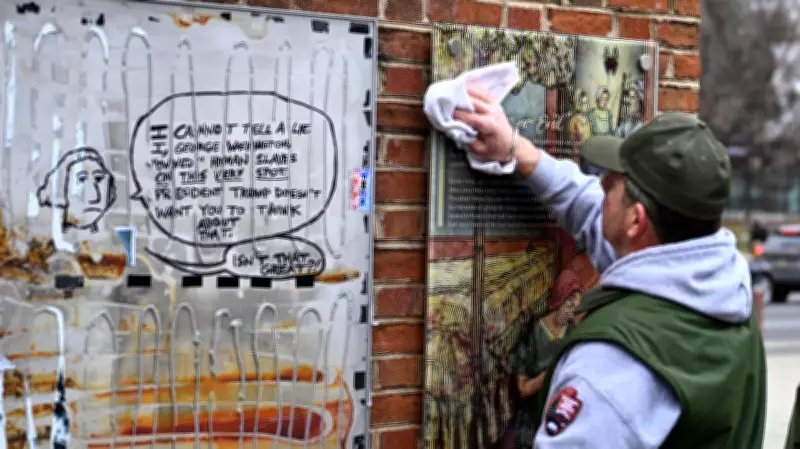
In a significant development for historical preservation, workers in Philadelphia have begun restoring a crucial exhibit detailing the lives of nine individuals who were enslaved at the former President's House. This action comes amid an ongoing and contentious legal confrontation between city officials and the Trump administration over control of historical narratives at National Park Service properties.
Federal Court Intervention and Restoration Deadline
Senior U.S. District Judge Cynthia Rufe issued a decisive injunction on Monday, compelling the restoration of the exhibit materials while the lawsuit proceeds through the legal system. The judge set a firm deadline of Friday for the Interior Department to complete this work, emphasizing the urgency of preserving historical integrity. Mayor Cherelle Parker personally visited the site on Thursday morning to express gratitude to the restoration workers, according to spokesperson Joe Grace.
Administration's Position and Exhibit Removal
The Trump administration maintains that it possesses exclusive authority to determine which historical stories are presented at National Park Service locations nationwide. This stance led to the abrupt removal of exhibits from the Philadelphia site last month, an action that immediately sparked controversy and prompted the city along with other exhibit supporters to file a lawsuit challenging the administration's decision.

The U.S. Attorney's Office has declined to comment on the restoration activities currently underway, as confirmed by a spokesperson. This silence underscores the sensitive nature of the legal proceedings and the broader implications for historical interpretation at federally managed sites.
Judge's Powerful Literary Comparison
In her comprehensive 40-page opinion, Judge Rufe delivered a striking comparison between the Trump administration's actions and the totalitarian regime depicted in George Orwell's dystopian novel "1984," which systematically revised historical records to align with its preferred narrative. Rufe, who was appointed by Republican President George W. Bush, asserted unequivocally that the federal government lacks the authority "to dissemble and disassemble historical truths."
The judge expressed profound concern about the potential consequences of leaving the President's House exhibit dismantled throughout the legal dispute. "If the President's House is left dismembered throughout this dispute, so too is the history it recounts," Rufe wrote with notable emphasis on the importance of maintaining historical continuity.
Preservation of Historical Integrity
Judge Rufe further warned about the dangers of potential replacement exhibits, stating that "the potential of having the exhibits replaced by an alternative script — a plausible assumption at this time — would be an even more permanent rejection of the site's historical integrity, and irreparable." This strong language highlights the court's recognition of the exhibit's significance in accurately representing the complex history of slavery at a site intimately connected to America's founding.
The restoration work specifically focuses on panels that were part of the slavery exhibit at the President's House Site on Independence Mall, where George Washington enslaved people during his presidency. This location holds particular historical importance as it sits adjacent to the Liberty Bell and Independence Hall, creating a powerful juxtaposition between America's founding ideals and the reality of slavery during that era.
The legal battle continues to unfold as both sides prepare their arguments, but the immediate restoration of the exhibit represents a temporary victory for historical preservation advocates who argue that complete and accurate historical narratives must be maintained at all National Park Service sites, regardless of political considerations or administrative changes.