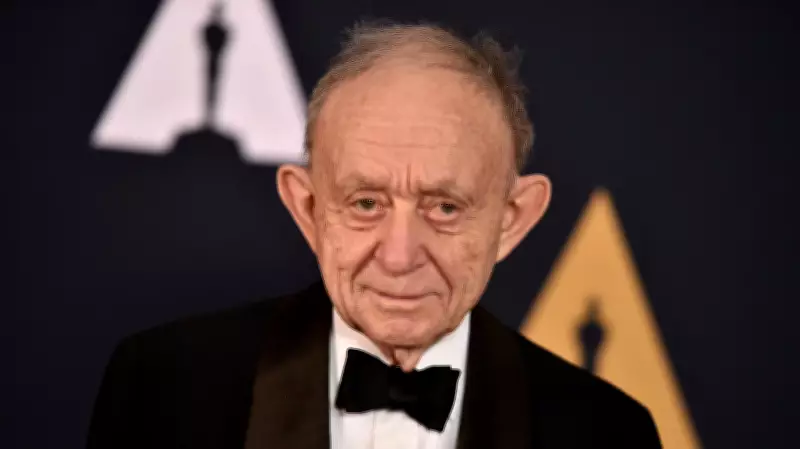
Frederick Wiseman, the revered director whose groundbreaking documentaries like "Titicut Follies" and "High School" offered an unflinching, poetic look into American institutions, died on Monday at the age of 96. His family and production company, Zipporah Films, announced his passing in a joint statement, though additional details were not immediately provided.
A Legacy of Unadorned Truth
Wiseman, who received an honorary Academy Award in 2016, completed more than 35 documentaries, some spanning several hours. His work, which aired on public television and was celebrated at festivals worldwide, covered diverse subjects from suburban high schools to horse race tracks, establishing him as a pivotal figure in modern documentary filmmaking. Starting his career in his mid-30s, Wiseman quickly rose to prominence alongside peers like D.A. Pennebaker and Robert Drew, helping to elevate documentaries as a vital and surprising art form.
The Wiseman Method
Wiseman patented a seamless, affecting style, often working with a minimal crew and serving as his own sound engineer. He avoided narration, prerecorded soundtracks, and title cards, focusing instead on raw, observational footage. Despite being associated with the "cinema verite" movement, he dismissed the term as "a pompous French term that has absolutely no meaning." His films, such as "Hospital," "Public Housing," and "Boxing Gym," used self-explanatory titles to delve into human behavior within institutional settings.

"The institution is also just an excuse to observe human behavior in somewhat defined conditions," Wiseman told The Associated Press in 2020. "The films are as much about that as they are about institutions."
Controversy and Acclaim
His 1967 film "Titicut Follies," shot at the Bridgewater State Hospital for the criminally insane in Massachusetts, featured shocking footage of inmate mistreatment, leading to a prolonged legal battle and restricted release for over two decades. State officials deemed it an intrusion on privacy, but a 1991 court ruling eventually lifted all restrictions, recognizing its artistic and historical value.
In 1968's "High School," Wiseman captured the mundane and revealing moments of life in a suburban Philadelphia school, from awkward sex education classes to earnest analyses of Simon & Garfunkel lyrics. Critic Pauline Kael praised the film for evoking empathy and extending "our understanding of our common life the way novelists used to."
A Lifelong Observer
Wiseman saw himself not as a muckraker but as a subjective, fair-minded observer. "I think it's as important to document kindness, civility and generosity of spirit as it is to show cruelty, banality and indifference," he said upon accepting his honorary Oscar. His later works, like "Crazy Horse," "At Berkeley," and "Monrovia, Indiana," demonstrated his enduring curiosity and adventurous spirit well into his 80s and 90s.
Born in Boston to a prominent attorney father and a mother who worked in a children's psychiatric ward, Wiseman attended elite institutions like Williams College and Yale Law School. After working in various legal and academic roles, he turned to filmmaking in his 30s, inspired by technological advances that allowed synchronous sound recording.
His career also included theater, staging plays by Samuel Beckett and adapting his film "Welfare" into an opera. In 2025, he took on brief acting roles in "Jane Austen Wrecked My Life" and "Eephus." Wiseman is survived by his two children; his wife, Zipporah, after whom his production company was named, died in 2021.
The statement from his family and Zipporah Films reads, "He will be deeply missed by his family, friends, colleagues, and the countless filmmakers and audiences around the world whose lives and perspectives were shaped by his unique vision."