Hollywood's Troubled History with Disability Portrayals
For decades, Hollywood has maintained a problematic relationship with disability representation on screen. Disabled characters have typically been reduced to simplistic tropes: objects of tragedy, sources of inspiration porn, or exhausting combinations of both. Celebrated American films like Rain Man and Forrest Gump—both Best Picture winners—perfectly illustrate this pattern. These films feature disabled characters who primarily exist to illuminate the journeys of nondisabled characters around them, with nondisabled actors frequently collecting awards for their performances.
Skepticism Meets Revolutionary Filmmaking
When I first sat down to watch Take Me Home, the debut feature from first-time filmmaker Liz Sargent starring her sister Anna, I approached with significant skepticism. Despite Sundance's description of the film as grounded in disability justice, and despite knowing that lead actor Anna Sargent is a disabled woman playing a version of herself with a largely disabled cast and crew, part of me simply didn't believe the promises. I had heard similar claims before—that conditions would be different, that disabled people would actually be centered this time.
What I failed to understand initially was how crucial the conditions built around a disabled performer truly are. When Anna appeared on screen, I had to confront my own assumptions immediately. Her presence was magnetic as she moved between explosive emotionality and subtle pathos with remarkable dexterity. In her first scene, Anna refuses a shower with the stubborn authority of someone who knows exactly who she is. From that moment, it became clear she was a force of nature and that the film belonged to her completely.

The Film's Core Question
Take Me Home follows Anna, a 38-year-old Korean adoptee with a cognitive disability, as she navigates a question every disabled person and their family eventually faces: What happens when the people who care for you can no longer do so? The film explores this universal concern with unprecedented authenticity and depth.
"I love that you questioned my intentions," Liz Sargent told me when I admitted my initial doubts. "I really do. And I'm glad that I proved you wrong. This film was centered around her, in process and in spirit and in the reason for making it and the power of it." We discussed a particularly nuanced scene where Anna commits a petty crime in a moment that manages to be both unsettling and hilarious. "People don't expect that," Liz noted.
The Dignity of Risk
Liz explained that many people, like myself, assumed the film would be secretly exploitative. While sympathetic to that suspicion, she wanted to challenge it fundamentally. "It says more about them not believing in her and her agency and just assuming she has no control over her choices and what she's doing," she observed. Society often assumes disabled people will either be set up to fail or set up for frictionless success, but Liz was attempting something more interesting: dignified risk.
"A lot of disabled people don't have the chance to take risks because people are so careful and afraid for them to fail," Liz explained. "But to me, that means that they're also not allowed to reach their greatness. They can't succeed. They can't do great things. This whole film was a risk. And the payoff is where the risk is, that we could fail. Anna has no short-term memory; she's never acted before. I'm a first-time filmmaker." This, she emphasized, represents the true dignity of risk.
Building Revolutionary Infrastructure
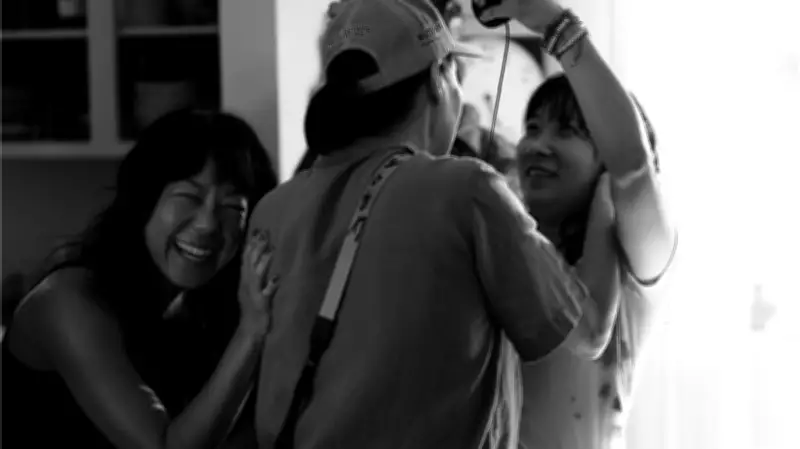
Preserving this dignity of risk doesn't happen accidentally. Liz constructed a production infrastructure most film sets have never attempted. She hired accessibility producer Cassie Palmisano, whose role extended far beyond typical coordination duties. Palmisano helped train the crew, managed Anna's daily care needs on set, and ensured everyone understood how to genuinely show up. Additionally, Liz brought in filmmaker Nathan Willis, a disabled documentarian, to witness and record the entire process.

"Something that stood out to me pretty quickly was how much effort they were putting into accessibility and care on the set," Willis recalled. "Usually, there's an accessibility coordinator that's hopefully trying to help make sure folks with different access needs are able to do their jobs. But that's more of a coordinator role. This was the first film I've ever seen that had an accessibility producer."
A Culture of Care Transforms Performance
Creating an atmosphere of care on a film set remains far from the industry norm. Productions typically move at breakneck speeds, with most professionals accustomed to setting aside their real needs during filming. The set of Take Me Home operated differently. "The accessibility producer was also making sure I was good," Willis noted. "With Parkinson's, I get fatigued, or my hands get super shaky, and I would just stop filming. I felt very cared for in that regard—like it was OK."
Many nondisabled people assume that the kind of care accessibility requires somehow reduces performance quality, as though allowing people to work within their full human reality represents a concession or lowering of standards. Take Me Home powerfully suggests the opposite is true. The infrastructure Liz built didn't just protect her sister—it liberated her creatively.
This culture of care fundamentally changed what became possible on screen. Every actor on set felt Anna's presence made them better performers, Willis explained. "Anna doesn't really have much of a short-term memory, so every scene, every take, was different. She never said the same thing the exact same way, or moved her body the exact same way she did in another take," he observed. "Your greatest goal as an actor is to make it feel like the lines you're saying are real and that you're saying them in the moment. Anna brought that out of the actors because she was so present."
A Radical Conclusion
That remarkable presence carries through to the film's final frames, where Take Me Home makes its most radical argument. The visual palette shifts from hazy and shadowed to bright and clean, showing Anna simply living on her own terms in a place that genuinely meets her needs. The ending feels utopian but not naively so.
Liz based this setting on dementia villages that exist outside the United States—places built on the fundamental premise that dignity is not a luxury. "It's grounded magical realism," she described. "I think it could be interpreted as a dream. Some people think it is a real place that exists. Some people think it's heaven. I think it's all of those things."
Proof of Concept for Systemic Change
Take Me Home is not a perfect film, and it will not single-handedly fix a broken system. However, it represents a vital experiment that generated crucial proof of concept: when you build the right conditions, disabled people will exceed everything you thought was possible. "Liz said, 'I just wanted to give my sister one good day, one easy day. And that's what she created,'" Willis recalled, then paused thoughtfully. "I don't think things are ever going to be perfect. But I try to cling to those good moments, those good days. Sometimes all you get is a moment."
The film stands as a powerful testament to what becomes possible when filmmaking prioritizes authentic representation, radical accessibility, and genuine care—challenging Hollywood to fundamentally reconsider how it approaches disability both on screen and behind the camera.