Hardy's Saddledome Performance: Strong Voice Overshadowed by Predictable Setlist
American country superstar Hardy brought his commanding vocal presence to Calgary's Saddledome on Thursday evening, but even his undeniable stagecraft couldn't elevate a night that felt formulaic and predictable. The artist, born Michael Wilson Hardy, delivered an efficient 90-minute set that covered his biggest hits while rarely venturing beyond the expected redneck-proud anthems that have defined his career.
An Odd Moment of Cynicism
Midway through the performance, Hardy introduced his only cover of the evening with a curious suggestion. "This might be a good time to go get a beer," he told the Saddledome audience before launching into a fairly unremarkable take on the Mott the Hoople/Bad Company classic Ready for Love. The singer dedicated the song to "all 17 of the Bad Company fans in Calgary tonight," a comment that felt strangely cynical given that his own material frequently borrows from classic rock traditions.
Hardy explained that his version of the song would appear on a tribute album celebrating Bad Company's induction into the Rock and Roll Hall of Fame. Yet his assumption that this 1970s rock standard would somehow be beyond his audience's comprehension seemed particularly puzzling considering how heavily his own songs lean on recycled hard-rock riffs and thundering drums rather than authentic country instrumentation.

Formulaic Approach to Stadium Performance
This apparent cynicism may stem from Hardy's background as a songwriter-for-hire, where he crafted paint-by-number hits for artists like Blake Shelton, Morgan Wallen, and Florida Georgia Line before achieving success under his own name. Throughout much of the Saddledome concert, he operated under the assumption that mainstream country fans prefer predictability over surprise in stadium settings.
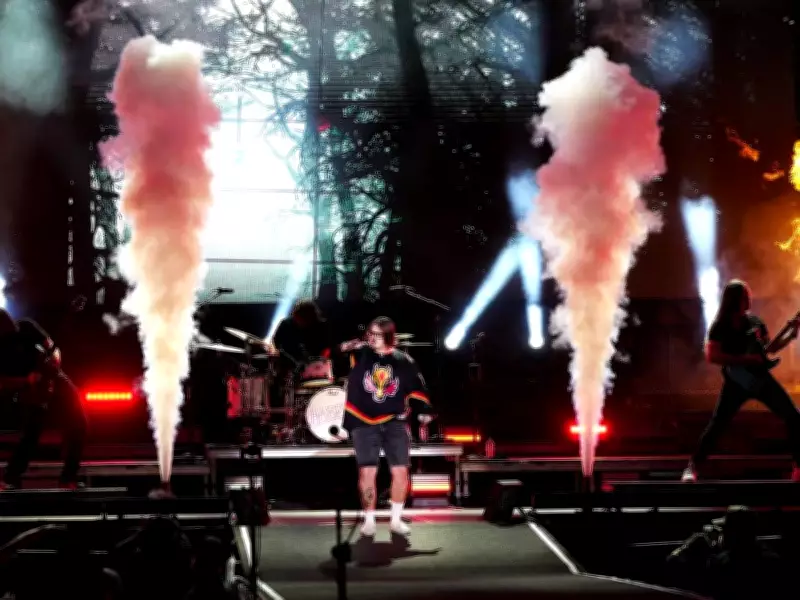
The performance opened with a brooding, gothic-inspired light show before Hardy appeared sitting beside a flaming barrel for a stripped-down, campfire-style rendition of the melancholy ballad Bottomland. This atmospheric beginning showcased his vocal power and stage presence, but the momentum proved difficult to sustain through the more formulaic portions of the set.
Musical Highlights Amid Predictability
Several moments did manage to break through the evening's overall flatness. An acoustic segment featuring Favourite Country Song, Signed, Sober You, and Girl With a Gun provided welcome intimacy in the cavernous arena. Hardy also made the obligatory stadium-show trek through the audience while performing God's Country, a song he wrote that became a massive hit for Blake Shelton.
The harder-edged numbers Sold Out and Psycho showcased the pummeling hard-rock outros that have become a Hardy trademark, complete with fire-gushing pyrotechnics. Two of his strongest narrative songs—Wait in the Truck (a domestic violence-themed murder ballad duet originally recorded with Lainey Wilson) and Jim Bob (a character study of a traumatized veteran)—offered poignant moments, though they didn't quite achieve the emotional depth of similar story songs by artists like Bruce Springsteen or Steve Earle.
Stage Design and Overall Impression
The Saddledome stage design featured several visually interesting elements, including a hunter's deer stand at the rear of the stage and Jumbotron imagery of a ready-to-shoot buck staring into the audience. While initially compelling, these visual motifs eventually began to feel like something from a Duck Dynasty-inspired fever dream—an appropriate metaphor for an artist whose aesthetic often feels calculated rather than authentic.
Throughout the performance, Hardy demonstrated why he has become a wildly successful hitmaker in contemporary country music. His voice remains commanding, his stage presence undeniable, and his understanding of stadium-show mechanics is clearly well-developed. Yet the Saddledome concert ultimately revealed an artist constrained by his own formulas, delivering technically proficient but emotionally predictable redneck-proud anthems that rarely challenged his audience or showcased his full creative potential.