Apple TV+’s “Widow’s Bay,” created by Katie Dippold, is a masterclass in blending horror and comedy, offering laugh-out-loud moments and spine-chilling scares. The show is set on a fictional island off the coast of Massachusetts, where Mayor Tom Loftis (Matthew Rhys) confronts supernatural horrors unique to the island. With Season 1 now concluded, here are 63 Easter eggs and horror tropes found across all 10 episodes, offering fans a reason to rewatch or dive into the “Widow’s Bay” mania.
Title Card and Stephen King Influences
The “Widow’s Bay” title card pays homage to Stephen King novels and short stories. Dippold told Comic Book Resources: “The people that designed it, they had designed a couple of different things, and this is one they did, and it just was perfect. And what I love about it is that it just taps into a kind of Stephen King nostalgia — and that’s what struck a chord for me.”
Stephen King is a huge influence on the show. Executive producer and director Hiro Murai explained in a Rolling Stone interview: “We’re playing in a sandbox that he built. That Northeast setting, the extraordinary happening to ordinary people. This genre is his playhouse.”

‘Jaws’ and ‘Twin Peaks’ References
The opening scene of Episode 1 evokes the dark intro of Steven Spielberg’s “Jaws.” Widow’s Bay itself resembles Amity Island, with costumes “bathed in a brown patina,” which costume designer Alex Bovaird called “Jaws Tech” in an interview with Whatever, Nevermind Substack. She noted that Dippold and Murai hired people who were into “Jaws” and “Twin Peaks,” describing the show’s tone as “American nostalgia trapped in amber.”
An extra in a blue button-down at Town Hall resembles a young Spielberg or Matt Hooper from “Jaws.” Character names also nod to horror: Rosemary and Ruth from “Rosemary’s Baby”; Dale from “Twin Peaks”; Gerrie sounds like “Carrie”; Tom could reference horror icon Tom Atkins; and Patricia might connect to Patricia Hitchcock.
Patricia’s appearance mirrors Wendy Torrance (Shelley Duvall) from “The Shining,” especially her hair and clothes in early episodes. Wyck is the Quint of “Widow’s Bay”—a fisherman who hates the island’s curse, just as Quint loathed sharks. The letters from each paragraph of the “Cannibalism in God’s House” article spell out “S.O.S D.A.M.N U.S.” Production designer Steve Arnold told The Set Set that the curtains and light fixture in the kitchen match the police chief’s house from “Jaws.”
When Wyck explains that the Fog steals souls, turning eyes white, it nods to “The Exorcist,” where Regan’s eyes turn white. A travel writer tells Tom, “I honestly don’t understand why this place isn’t Martha’s Vineyard,” referencing “Jaws” filming location. Tom’s yell, “There’s something in the fog,” directly references the movie “The Fog.”
Episode 2: ‘Psycho,’ ‘The Shining,’ and ‘IT’
The haunted Breakwater Inn pays homage to the Bates’ home from “Psycho” and Edward Hopper’s “House by the Railroad.” Arnold noted that the cupola was added in post-production. The blue Victorian damask wallpaper tributes “The Shining.” Tom hears a New Year’s celebration through bathroom grates, similar to the haunting party in “The Shining.” Tom meets Willy the Clown, mimicking Jack’s meeting with Lloyd the ghost bartender.
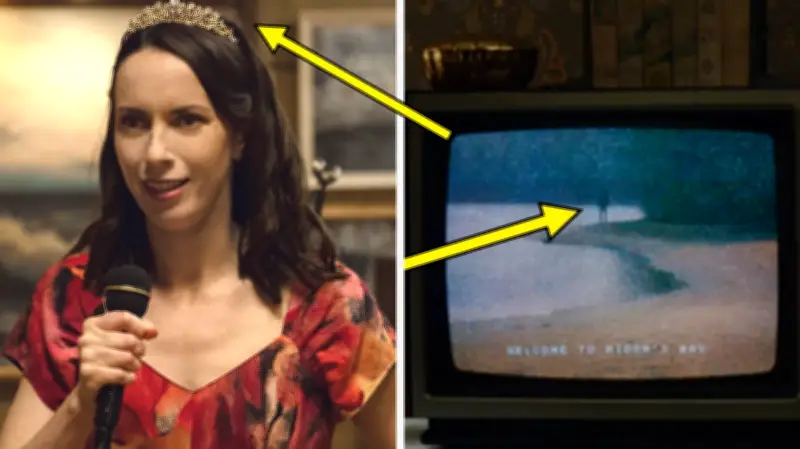
A random figure in the welcome video uses the Monumental Horror-Image visual. Tom’s encounter with a killer clown ghost connects to Pennywise from “IT.” The skeleton wears the same shirt as Tom. Kurt stays in the captain’s suite for 10 seconds but time moves differently, like in “1408”; the room appears destroyed when the sheriff opens the door. Black mold behind wallpaper references films like “Get Out” and “The Haunting of Hill House.”

Episode 3: ‘Jaws,’ ‘The Blair Witch Project,’ and More
Episode 3 heavily references “Jaws,” including a dopey shark drawing on a chalkboard and a man standing in front of a door like in “The Blair Witch Project.” The Sea Hag’s design resembles the old lady from “It Follows” and Sadako from “The Ring.” Garrett the lighthouse keeper references “Edgar Allan Poe’s Lighthouse Keeper.” The inaugural swim scene mirrors Chrissie’s in “Jaws,” with Tom holding an ocean marker, and underwater shots with “Jaws”-like music.
Reverend Bryce approaches a well resembling the one in “The Ring.” His character draws on religious horror tropes from “The Exorcist,” “Midnight Mass,” and “The Walking Dead.” A disorienting sequence where the Sea Hag hands Tom tea feels like the tea-hypnotized scene in “Get Out.” The Sea Hag’s long nails in the bathtub reference “A Nightmare on Elm Street.”
Episode 4: ‘Carrie,’ ‘The Wicker Man,’ and ‘The Babadook’
Episode 4 opens with Patricia in a Pattiwagon wearing plaid, a pattern often used in horror (e.g., “Scream” villains). A copy of “The Shining” appears in a donation box. The book “Your Turn” is by Lucy Fours (like Lucifer). A fly symbolizes demons, decay, and death. Patricia’s “manic writing” on her bed mirrors Jack’s in “The Shining.” The evil spirit book may derive from “The Babadook,” which Dippold wore as a Halloween costume in 2016.
Kate O’Flynn told TV Insider that “Carrie” was a huge influence; Patricia wears a tiara like Carrie after prom queen. Mean girls mimic those in the 1976 film. Dippold said “The Wicker Man” influenced Episode 4, reflected in Patricia’s crown and the fire sacrifice scene where people walk into the ocean. Stick figures resemble those in “The Blair Witch Project.”
Episode 5: ‘The Ring,’ Slasher Tropes, and Cursed Islands
Episode 5 features manic drawings reminiscent of “The Ring.” A group of teens evokes slasher films like “Scream” and “The Texas Chain Saw Massacre.” Wyck gives Gerrie a journal page about a curse on the island, a trope seen in “Old” and “Shutter Island.”
Episode 6: ‘The Witch,’ ‘Misery,’ and ‘Breaking Bad’
Episode 6, a flashback to 1702, gives Robert Eggers’ “The Witch” vibes. Richard cuts his hand to make a pact with the island, a common horror trope (e.g., “IT,” “Practical Magic”). Sarah tells a priest, “He is not consorting with the devil; he IS the devil,” echoing Jesse’s line in “Breaking Bad.” Sarah’s attempt to poison her husband fails like Paul’s in “Misery.”
Episode 7: Cursed Items and ‘Jaws’ Homages
Wyck and Patricia dig up Richard’s grave to find a cursed item, similar to “Talk to Me,” “The Ring,” and “The Evil Dead.” Wyck’s story about Gerrie’s brother dying while fishing mirrors Quint’s USS Indianapolis tale in “Jaws.” Tom says, “We’re gonna need a different plan,” a twist on “You’re gonna need a bigger boat.”
Episode 8: ‘Halloween’ and ‘The Lovely Bones’
Episode 8 pays homage to Michael Myers and “Halloween,” with the Boogeyman returning to kill Patricia. Negative space and open doors signal danger. The mean girls read “The Lovely Bones,” which parallels Patricia’s story. Fake seagulls at the gas station may reference “Night of the Seagulls.” Patricia sets the Boogeyman on fire, like in “Halloween II.”
Episodes 9 and 10: ‘Sleepy Hollow,’ ‘Lost,’ and ‘A Clockwork Orange’
Horror references are minimal in the finale, but a headless statue resembles the Headless Horseman from “The Legend of Sleepy Hollow.” Sacrifice instruction videos mirror Dharma Initiative orientation from “Lost.” Murai told Rolling Stone that the electric chair scene was inspired by “A Clockwork Orange,” adding, “Things that make you feel like someone is going to be put here against their will. And hanging off the top is the eye contraption from ‘A Clockwork Orange’ so whatever there is coming out of that steel door they have to look at it.”