Alberta Indigenous and Rural Communities Demand Federal Environmental Review of $16.5 Billion Carbon Capture Project
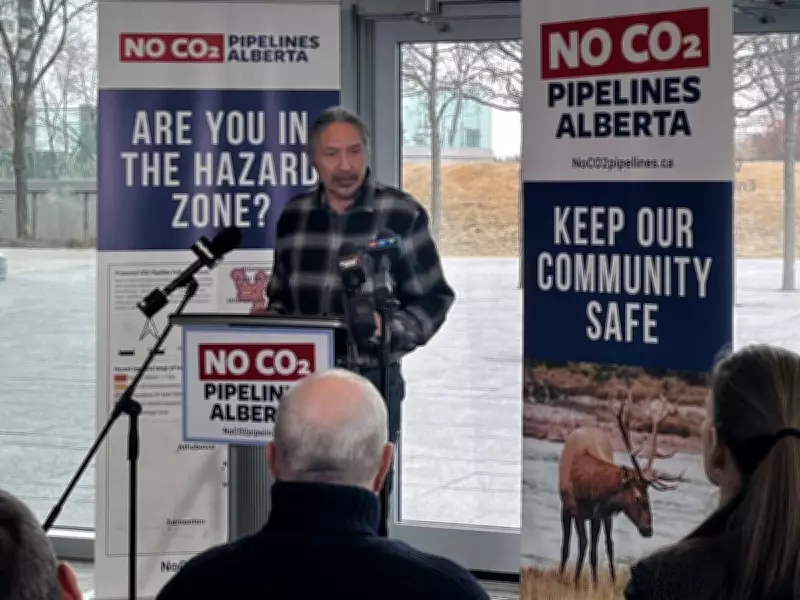
A coalition of Indigenous leaders, farmers, and landowners has formally called upon the federal government to conduct a comprehensive environmental impact assessment of the Pathways Alliance's proposed $16.5 billion carbon capture, utilization, and storage (CCUS) project. The newly formed No CO2 Pipeline coalition launched this week with a press conference at the Alberta legislature grounds, where members voiced strong opposition to the current project plans.
Concerns Over Consultation and Safety
The coalition has sent a formal letter to federal authorities expressing significant concerns about the lack of meaningful consultation regarding the 400-kilometer pipeline that would connect more than 20 oilsands facilities in northern Alberta to an underground CO2 storage hub near Cold Lake. Amil Shapka, a retired dentist and landowner from St. Paul, Alberta, who co-founded the coalition, stated that repeated attempts to engage with industry and government representatives over the past two years have yielded more questions than answers.
"For the last two years, my neighbours and I have been reaching out to industry and government, looking for answers, only to be left with more questions. We deserve answers," Shapka emphasized during the press conference. "An energy serfdom is hardly a sovereign Canada, or, for that matter, a sovereign Alberta."

Regulatory Decisions and Coalition Demands
The coalition's demand comes after the Alberta Energy Regulator announced in 2024 that it would not require the Pathways Alliance—comprising major oilsands producers including Suncor Energy, Imperial Oil, Cenovus Energy, and Canadian Natural Resources—to submit an environmental impact assessment report. However, the regulator noted this decision could change if new information emerges.
Chief Allan Adam of Athabasca Chipewyan First Nation joined other Indigenous leaders at the press conference, highlighting the importance of proper consultation with affected communities. The coalition argues that without a comprehensive federal environmental impact assessment, they will continue to oppose the project in its current form.
Government Response and Broader Implications
Environment and Protected Areas representative Grant Hunter expressed surprise at the opposition, noting that the government is working to ensure the carbon capture project is included in the memorandum of understanding between Alberta and Canada. Hunter suggested this agreement could potentially lead to future pipeline developments while maintaining high environmental standards.
The coalition is also requesting that the federal environment minister provide feedback on the Draft Co-operation Agreement on Environmental and Impact Assessment between Alberta and Ottawa. Members have raised "significant concerns" about proposals that would allow Canada to defer to Alberta for impact assessments, arguing that federal oversight is essential for projects of this scale and potential environmental consequence.
Shapka and other coalition members have conducted independent research into the potential impacts of CO2 pipeline ruptures, citing safety concerns that they believe warrant thorough federal examination. The group's formation represents growing organized resistance to major energy infrastructure projects that communities feel have been developed without adequate consultation or consideration of local impacts.